Picking the right Tube Mill in 2026 isn't just about comparing their claimed speeds on paper. Buyers really need to look beyond that — things like how precise the forming process is, the stability of the welds, how energy-efficient the machine is, and whether there's good long-term technical support available. Just because a machine is fast doesn’t mean it’s cheap in the long run — slow tooling changes or late spare parts can turn it into a money pit.
Back in 2024, the World Steel Association reported that global crude steel production hit around 1.88 billion tonnes. That massive industrial footprint keeps fueling demand for welded tubes, especially in sectors like construction, auto manufacturing, energy infrastructure, furniture, and precision engineering. Meanwhile, the International Energy Agency keeps stressing how important efficiency and electrification are for industry today. So, on top of performance, factors like power consumption, automation, and how easy it is to get maintenance—these are things you really wanna keep in mind.
Of course, people’s market forecasts don’t always match up. Reports from firms like Grand View Research, Fortune Business Insights, and Research and Markets all say the steel tube and pipe market is still growing. But their definitions of the market and how they forecast things can differ quite a bit — it’s worth paying attention to that. So, when you're making a call, it’s smart to weigh these published stats with real-world feedback from other buyers and field experiences — don’t just rely on a single forecast.
In this guide, we’re looking at ten top Tube Mill options for buyers around the world in 2026. We consider everything from the variety of products they can handle, flexibility with strip widths, how fast the lines run, welding controls, the precision of dimensions, safety features for operators, after-sales support, and overall ownership costs. Companies like Fives, SMS Group, Danieli, and T&H Lemont each bring their unique engineering strengths to the table. And don’t forget smaller specialists — they might offer some really tailored solutions if you need something custom.
No machine is perfect, though. How well it performs really depends on factors like the type of material you’re working with, tube sizes, production volume, your factory setup, and how good the local service support is. Before you make a final decision, it’s a good idea to ask for references from verified users, see results from trial runs, review energy consumption data, and have a clear plan for spare parts and maintenance. Trust me, taking these steps now can save you a lot of headaches later.
What Tube Mills Are and How They Work
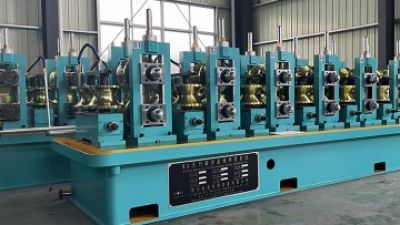
A tube mill is a production line that turns flat metal strip into round, square, or rectangular tubing. Most welded models begin with a steel coil, which a decoiler feeds into the line. Guide rolls keep the strip centered. Forming stands gradually bend its edges toward each other. This gradual shaping matters. Sudden pressure can create wrinkles, uneven walls, or unstable welding.
Process
At the weld station, the meeting edges are heated and pressed together, often by high-frequency electrical energy. A scarfing tool removes excess weld bead from the outside surface. Sizing rolls then correct the tube’s dimensions and improve its straightness. A flying saw cuts continuous tubing into specified lengths without stopping production. Sensors monitor speed, temperature, strip position, and weld conditions. Operators still check surfaces and sample dimensions because instruments can miss developing defects.
In practical plant inspections, strong results come from matching mill design to material grade, thickness, diameter, and expected output. A line built for thin decorative tubing may struggle with heavy structural sections. Tooling changes also require time, skill, and careful alignment. The process looks simple from a distance. It is not. Small setup errors can produce recurring cracks or oval tubes, wasting an entire coil before anyone notices. Buyers should review trial records, maintenance access, spare tooling, and safety controls, not only advertised speed. Even experienced teams revise settings after observing real production, because laboratory assumptions rarely capture every variation in incoming strip.
Key Tube Mill Specifications Global Buyers Should Compare
10 Best Tube Mills for Global Buyers in 2026?
A serious comparison starts with the material range, not the catalog photos. The World Steel Association reported 1.892 billion tonnes of crude steel production in 2023. That scale creates pressure for flexible, stable tube production. Check strip width, thickness, yield strength, and coil weight. Confirm the finished tube diameter range. A line rated for 20–76 millimetres may not perform equally across every size.
Line speed needs careful interpretation. Ask whether the quoted speed applies to thin-wall carbon steel or a wider production range. For a High Frequency Tube Mill, compare welding frequency, inverter power, impedance control, and weld-temperature monitoring. These details affect burn-through, porosity, and rejected lengths. Inspect the forming stands, roll material, shaft diameter, and adjustment method. Small alignment errors can produce visible seam marks.
The International Energy Agency’s Energy Efficiency 2024 report keeps industrial electricity use under scrutiny. Buyers should request motor efficiency data, idle-load consumption, and power use per tonne. Automation also matters. Review edge-tracking accuracy, automatic gauge control, fault recording, and remote diagnostics. Request sample production records, not only laboratory claims. ISO 9001 certification supports process discipline, but it does not guarantee tube quality. No specification sheet is perfect. Leave room for operator skill, maintenance delays, and local service capacity. A faster line may still lose money when changeovers take three hours.
How the Ten Best Tube Mills Are Evaluated
For global buyers in 2026, evaluating the ten best tube mills requires more than comparing production speed. A reliable review begins with the buyer’s actual tube range, material grades, wall thickness, and target output. A Welded Tube Mill should form strip smoothly, maintain stable alignment, and produce consistent welds during long shifts. Ask for measured results, not broad promises.
Experienced evaluators inspect the forming stands, welding system, sizing section, cutting unit, and control interface. They check whether operators can adjust the line without excessive downtime. A practical factory visit should include coil loading, changeover, weld monitoring, and finished-tube inspection. Look closely at sample tubes. Uneven edges, burn marks, or changing diameters may reveal hidden weaknesses. Small details matter.
Documentation also separates a strong supplier from an attractive sales presentation. Buyers should review material certificates, electrical drawings, maintenance schedules, spare-parts lists, and factory acceptance test records. References from similar applications can confirm real performance, although references are never perfect. Energy use, guarding, training, remote support, and delivery planning deserve equal attention. A low purchase price may become expensive after repeated stoppages. No scoring model is flawless. A thoughtful evaluation leaves room for uncertainty, tests critical claims, and records every technical decision before signing.
Leading Tube Mill Types for Different Production Needs
Global buyers need different tube mill types for different production targets. A high-frequency welded Steel Tube Mill suits carbon-steel tubes, furniture sections, and general construction. It offers continuous forming, fast welding, and relatively low material waste. A precision ERW line is better for tighter dimensions, thinner walls, and visible surface requirements. It needs disciplined strip preparation. Small errors become obvious later.
For heavy-wall oil, gas, or pressure applications, a seamless tube mill remains important. It avoids a welded seam but usually requires higher investment and more complex process control. Spiral welded mills suit large-diameter water, piling, and infrastructure pipes. Their flexible diameter range can reduce tooling changes. Stainless tube mills need cleaner handling, dedicated tooling, and careful cooling. Otherwise, surface marks may appear under bright inspection lights.
The World Steel Association reported 1.89 billion tonnes of crude steel production in 2023, showing the scale behind global tube manufacturing. Its World Steel in Figures 2024 also highlights steel’s continuing role in construction, transport, and engineering. Grand View Research’s 2024 steel pipes market assessment identifies energy, construction, and infrastructure as major demand sectors. Buyers should compare line speed, wall thickness, diameter range, automation, and service access. A cheaper line may consume more labor. That lesson is easy to miss. I would also test sample coils before ordering, because laboratory specifications rarely reveal every production weakness.
10 Best Tube Mills for Global Buyers in 2026? - Leading Tube Mill Types for Different Production Needs
| No. |
Tube Mill Type |
Primary Material |
Typical Tube Size Range |
Typical Wall Thickness |
Typical Line Speed |
Typical Production Capacity |
Best Suited For |
Main Production Advantages |
| 1 |
High-Frequency ERW Round Tube Mill |
Carbon steel and low-alloy steel strip |
OD 12–165 mm |
0.6–6.0 mm |
30–120 m/min |
Approximately 2–15 t/h |
General structural tubes, furniture tubes, machinery components and material-handling products |
Continuous longitudinal welding, good dimensional repeatability and efficient production of standard round tubes |
| 2 |
ERW Square and Rectangular Tube Mill |
Carbon steel, galvanized strip and low-alloy steel |
20 × 20 to 150 × 150 mm; rectangular sections up to about 200 × 100 mm |
0.8–6.0 mm |
20–100 m/min |
Approximately 2–12 t/h |
Construction frames, racking, agricultural equipment, transport structures and general fabrication |
Produces hollow structural sections with high bending stiffness and efficient material use |
| 3 |
Precision Small-Diameter Tube Mill |
Low-carbon steel, stainless steel, copper-coated steel and other precision strip |
OD 6–50 mm |
0.3–2.5 mm |
40–150 m/min |
Approximately 0.5–6 t/h |
Automotive components, heat-exchanger parts, bicycle components, precision furniture and instrument tubing |
Fine forming control, stable weld quality and tight dimensional tolerances for small profiles |
| 4 |
Stainless-Steel High-Frequency Tube Mill |
Austenitic, ferritic and selected duplex stainless-steel strip |
OD 10–114 mm |
0.5–4.0 mm |
15–80 m/min |
Approximately 0.5–8 t/h |
Food-processing equipment, architectural tubes, chemical-service components and decorative tubing |
Designed for corrosion-resistant materials, controlled heat input and clean weld-zone finishing |
| 5 |
API and Oilfield Longitudinal-Welded Tube Mill |
Carbon and micro-alloyed steel strip or plate-grade feedstock |
OD 114–508 mm |
3.0–16 mm |
8–35 m/min |
Approximately 3–25 t/h |
Line pipe, piling, structural pipe and demanding industrial conveying applications |
Heavy-duty forming and welding systems support large diameters, thicker walls and stringent inspection requirements |
| 6 |
Galvanized and Pre-Finished Tube Mill |
Pre-galvanized, zinc-coated, painted or other surface-treated steel strip |
OD 15–120 mm |
0.7–4.0 mm |
25–100 m/min |
Approximately 1–10 t/h |
Greenhouse frames, electrical conduit, light construction, fencing and HVAC support systems |
Forms coated strip with reduced post-processing, helping preserve surface appearance and corrosion protection |
| 7 |
Thick-Wall Structural Tube Mill |
High-strength carbon steel and low-alloy structural steel |
OD 60–219 mm |
4.0–12 mm |
10–45 m/min |
Approximately 3–20 t/h |
Heavy structural columns, bridge components, mining equipment and load-bearing frames |
High forming force, robust weld systems and strong support for thick-wall hollow sections |
| 8 |
Welded Tube Mill with Online Sizing and Cut-to-Length |
Carbon steel, stainless steel and coated steel, depending on configuration |
OD 20–168 mm |
0.8–6.0 mm |
20–100 m/min |
Approximately 2–15 t/h |
Mixed-order production requiring multiple lengths, rapid changeovers and finished bundles |
Integrates sizing, non-destructive inspection options and automatic cutting to reduce handling and scrap |
| 9 |
Cold-Rolled Precision Welded Tube Mill |
Cold-rolled low-carbon steel, stainless steel and high-quality alloy strip |
OD 8–76 mm |
0.4–3.0 mm |
30–120 m/min |
Approximately 0.5–8 t/h |
Automotive exhaust parts, precision mechanical tubing, office equipment and appliance components |
Supports smooth surfaces, narrow dimensional tolerances and consistent appearance after welding |
| 10 |
Spiral-Welded Large-Diameter Pipe Mill |
Hot-rolled carbon steel and low-alloy steel coil |
OD 400–3,000 mm |
5–25 mm |
1–8 m/min |
Approximately 5–40 t/h |
Water transmission, piling, slurry transport, low-pressure pipelines and large-scale infrastructure |
Produces very large diameters from relatively narrow coil widths and offers flexible diameter-to-wall combinations |
Data note: The figures shown are representative engineering ranges for typical 2026 production configurations. Actual speed, capacity, tube dimensions and achievable tolerances depend on steel grade, strip width, welding method, tooling design, line automation, inspection requirements and product standards.
Global Standards, Certifications, and Export Requirements
Global tube-mill buyers should treat compliance as a production requirement, not a paperwork exercise. The World Steel Association reported about 1.89 billion tonnes of crude steel production in 2023. This scale increases demand for reliable forming, welding, sizing, and testing equipment. A credible supplier should provide ISO 9001 quality controls, traceable material records, calibrated gauges, and documented factory acceptance tests. ISO 14001 can support environmental management, while ISO 45001 addresses workplace safety. These certificates help, but they do not prove stable weld quality.
Export readiness also depends on the destination market. Machinery shipped to the European Economic Area may require CE conformity, a risk assessment under ISO 12100, and electrical documentation aligned with IEC 60204-1. Buyers should verify the correct HS code, commercial invoice, packing list, certificate of origin, insurance, and bill of lading. For steel products, EN, ASTM, API, or local standards may apply to the finished tube, not only the mill itself. Requirements can differ by diameter, wall thickness, end use, and pressure rating.
Tips: Request a sample quality dossier before signing. It should include weld-test results, dimensional tolerances, spare-parts lists, manuals, and FAT procedures. Ask whether the supplier can support remote commissioning and local-language safety labels. A certificate is useful. It is not enough. The ISO Survey records more than one million ISO 9001 certificates worldwide, yet implementation quality still varies. That gap deserves careful questioning.
Tube Mill Costs, Maintenance, and After-Sales Support
10 Best Tube Mills for Global Buyers in 2026: Tube Mill Costs, Maintenance, and After-Sales Support
A tube mill’s purchase price is only one part of the investment. Buyers should calculate tooling, installation, operator training, spare parts, freight, and energy consumption. A lower-priced machine may require more frequent adjustments or expensive imported components. Request a clear cost breakdown before signing any contract. Include production speed, tube diameter range, wall thickness, and material grade in the quotation.
Maintenance directly affects output quality. Operators should inspect forming rolls, weld alignment, bearings, guides, and coolant flow during each shift. Roll wear can create uneven seams, scratches, or unstable dimensions. Keep measuring tools calibrated, not merely clean. A practical maintenance plan includes daily lubrication checks, weekly fastener inspections, and scheduled roll maintenance based on production hours. Small details matter. However, maintenance schedules are not always perfect. Actual wear depends on steel quality, workload, and operator habits.
After-sales support deserves the same attention as machine specifications. Confirm response times, remote diagnostic procedures, service engineer availability, and spare-parts stock. Ask whether manuals include electrical drawings, maintenance intervals, and troubleshooting steps. A reliable supplier should provide commissioning support and documented training. During evaluation, request references from factories using similar materials and sizes. Buyers should also test communication before purchase. Slow answers during negotiation may become slower support after installation. A written service agreement reduces uncertainty, although it cannot replace competent local technicians.
How to Select the Right Tube Mill for Your Factory
Choosing the right Tube Mill Machine starts with your actual production plan, not a sales brochure. Define the tube diameter range, wall thickness, steel grade, and target output. A machine designed for thin carbon steel may struggle with thicker stainless steel. Check whether the forming stands can handle your required dimensions without frequent adjustments.
Review the complete production line. Inspect the uncoiler, forming section, welding unit, sizing stands, cutting system, and control cabinet. Ask for verified data from similar factories. During a site visit, examine weld consistency, surface marks, changeover time, and noise levels. A five-minute demonstration is not enough. Request trial production using your own material and specifications.
Think about maintenance before signing a purchase agreement. Confirm spare-part availability, technician response times, training, and electrical requirements. Measure your workshop entrance and floor capacity carefully. Small layout errors can delay installation. Energy use also matters, especially when the mill runs continuously. In practice, the cheapest machine may create higher costs through scrap, downtime, and difficult setup. I have seen buyers focus too heavily on maximum speed. That choice can be disappointing when operators cannot maintain stable quality. Leave room for future products, but avoid paying for capacity your factory will not use. Reliable records, clear acceptance standards, and practical operator feedback should guide the final decision.
Automatic ERW Carbon Steel Tube Mill: Precision Manufacturing Solutions from China Suppliers
Automatic ERW carbon steel tube mills are becoming essential for manufacturers seeking stable output, repeatable dimensions, and flexible product ranges. The World Steel Association reported global crude steel production of approximately 1.84 billion tonnes in 2024, highlighting the continuing scale of steel demand and the importance of efficient downstream processing. An automated mill converts steel strip into welded round, square, and rectangular pipes with controlled forming, welding, sizing, and cutting operations.
Designed for precision manufacturing, this tube mill handles pipe diameters from 13 to 60 mm and material thicknesses from 0.6 to 2.5 mm. Its dimensional tolerance can be maintained at approximately 0.5% of the pipe’s outside diameter, supporting applications where consistent fit, appearance, and structural performance are required. Automatic production also helps reduce manual intervention, improve line consistency, and increase productivity for China-based suppliers serving construction, furniture, automotive, and general engineering markets.
The equipment can be configured for different production requirements, with customized spare parts and machine colors available. A one-year warranty supports initial operation and maintenance planning, while the robust ERW structure is engineered for continuous industrial service. By combining adaptable sizing, controlled welding, and reliable forming performance, this tube mill provides a practical solution for manufacturers expanding their carbon steel pipe capacity.
FAQS
: Check strip width, thickness, yield strength, and coil weight. Confirm the finished tube diameter range. Catalog photos are not enough.
Ask which material and wall thickness support the quoted speed. Thin-wall carbon steel may run faster than heavier sections. Test real coils.
Compare welding frequency, inverter power, impedance control, and weld-temperature monitoring. These features can reduce porosity, burn-through, and rejected lengths.
Review the forming stands, roll material, shaft diameter, and adjustment method. Small alignment errors may create visible seam marks. Tiny errors matter.
High-frequency welded lines suit carbon steel and general construction tubes. Precision lines support tighter dimensions. Seamless mills suit heavy-wall pressure applications.
Stainless production needs cleaner handling, dedicated tooling, and careful cooling. Poor control may leave surface marks under bright inspection lights.
Request motor efficiency, idle-load consumption, and power use per tonne. Check edge tracking, automatic gauge control, fault recording, and remote diagnostics.
No. Certification supports process discipline, but it does not guarantee tube quality. Operator skill, maintenance delays, and service access still affect results.
A lower purchase price may hide higher labor use or long changeovers. Three-hour changeovers can erase savings. I would test sample coils before ordering.
Conclusion
This guide explains what a tube mill is, how it transforms metal strip into accurately formed and welded tubes, and which specifications matter most to global buyers. It compares forming capacity, tube size range, production speed, material compatibility, welding method, automation, energy efficiency, and dimensional control. The ten best tube mills are evaluated through practical criteria such as performance, reliability, operating flexibility, safety, maintenance needs, total ownership cost, and technical support.
The article also outlines suitable tube mill types for different production goals, from general-purpose manufacturing to high-volume or specialized applications. It highlights the importance of international standards, electrical and safety certifications, export documentation, installation requirements, spare-parts availability, and after-sales service. Finally, buyers receive a structured approach for selecting equipment based on factory space, target products, production volume, workforce capabilities, budget, maintenance resources, and future expansion plans.