


 Tube Mill Consumables: Inspection & Replacement Guide


How to Improve ERW Tube Surface Quality in Production
Why Are My ERW Pipes Scratched After Production?
ERW pipes are usually scratched because of tube mill roller damage, poor roller polishing, incorrect roll pass design, excessive forming pressure, or machine alignment problems. Manufacturers should identify the defect source before replacing tooling or adjusting production parameters.
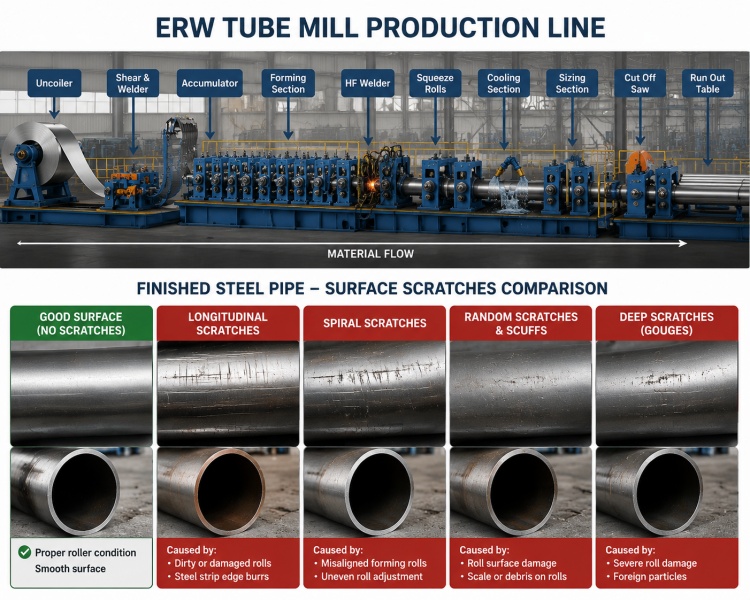
Tube surface scratches are usually caused by a combination of tube mill roller design, roller surface condition, improper polishing, excessive forming pressure, and production alignment problems. In most ERW tube mill production lines, scratches are not caused by only one factor; however, damaged or poorly finished forming rollers are among the most common reasons because the roller directly contacts the steel strip and transfers defects onto the final tube surface.
A correct solution requires checking the complete forming process, including roll pass design, roller material, roller polishing quality, strip alignment, lubrication condition, and machine adjustment parameters.
Key Takeaways
- Tube surface scratches are mainly caused by direct contact between the tube and forming/sizing rollers.
- Poor tube mill roller design can create excessive stress concentration and surface damage.
- Roller polishing quality directly affects the final pipe appearance.
- Deep scratches repeating at the same position usually indicate roller surface damage.
- Random scratches are often related to steel debris, poor cleaning, or material handling.
- Excessive forming pressure can force the strip surface against damaged rollers.
- Regular roller inspection and maintenance can significantly reduce rejection rates.
- High-quality ERW Tube Mill production requires balance between mechanical design, tooling precision, and process control.
What Are Tube Surface Scratches?
Problem
For tube manufacturers, surface quality is becoming increasingly important.
A pipe is not only judged by:
- Outer diameter accuracy
- Wall thickness tolerance
- Welding strength
but also by:
- Surface appearance
- Smoothness
- Consistency
This is especially true for:
- Furniture tubes
- Decorative stainless steel tubes
- Galvanized pipes
- Automotive tubes
- Precision welded tubes
A customer buying a high-end decorative tube may reject an entire production batch because of visible longitudinal scratches, even when mechanical performance meets the specification.
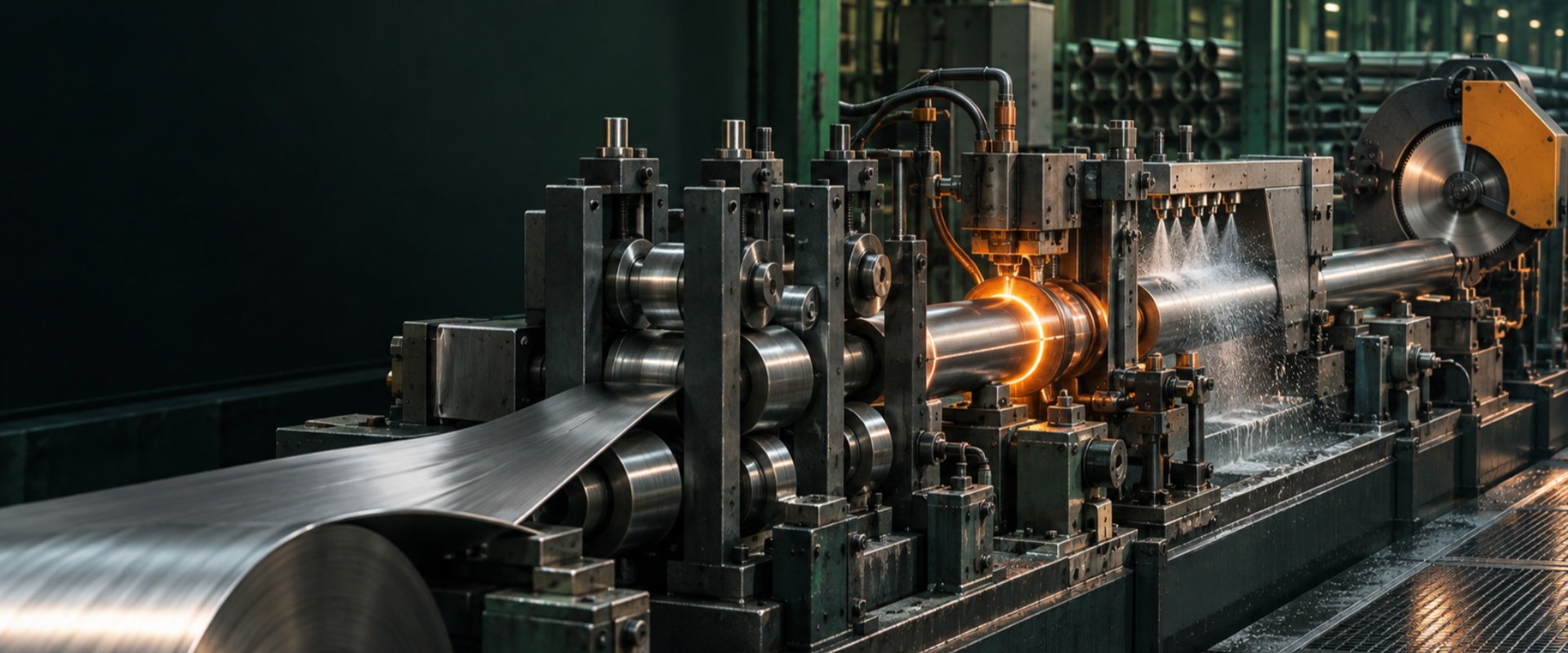
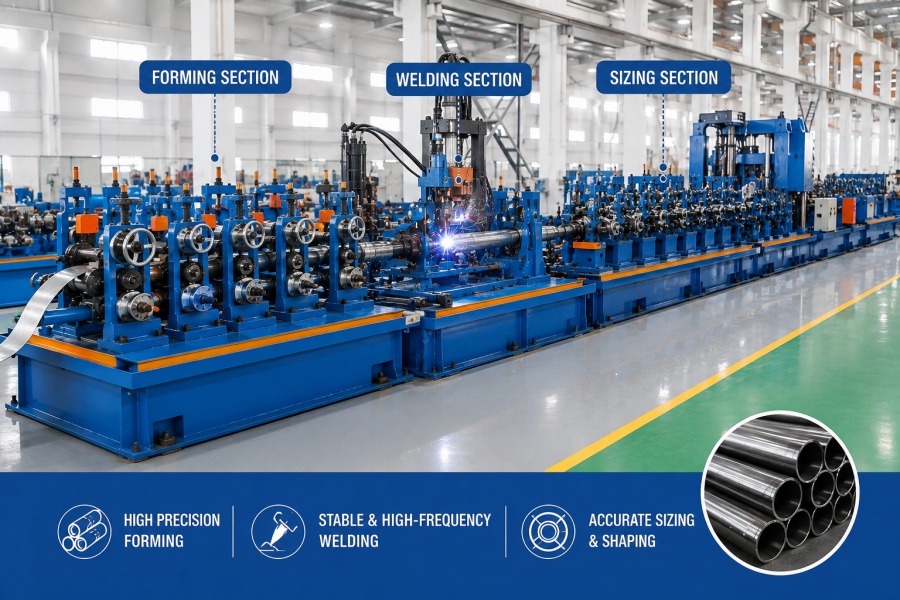
In an ERW Tube Mill, the steel strip passes through multiple forming stands before reaching the welding and sizing sections. Every roller that contacts the material has the possibility of influencing the final surface condition.
Therefore, tube surface scratches should be considered a complete production system issue rather than a simple polishing problem.
Common Types of Tube Surface Scratches
1. Continuous Longitudinal Scratches
Appearance:
- Long straight lines
- Same position on every tube
- Same direction as tube length
Typical Causes:
- Damaged forming roller
- Roller groove
- Metal pickup on roller surface
- Incorrect roller adjustment
When a damaged roller continuously contacts the tube, the defect pattern is transferred repeatedly to every product.
2. Periodic Roller Marks
Appearance:
- Repeated marks
- Equal spacing
- Similar depth
Possible Causes:
- Roller surface damage
- Bearing vibration
- Roll rotation instability
These defects often indicate that the problem is related to a specific production stand.
2. Periodic Roller Marks
Appearance:
- Repeated marks
- Equal spacing
- Similar depth
Possible Causes:
- Roller surface damage
- Bearing vibration
- Roll rotation instability
These defects often indicate that the problem is related to a specific production stand.
3. Random Scratches
Appearance:
- Different positions
- Different lengths
- No fixed pattern
Possible Causes:
- Steel debris
- Dirty production line
- Poor strip surface condition
- Incorrect material handling
Foreign particles trapped between steel strip and machine components can create long scratches during continuous production.
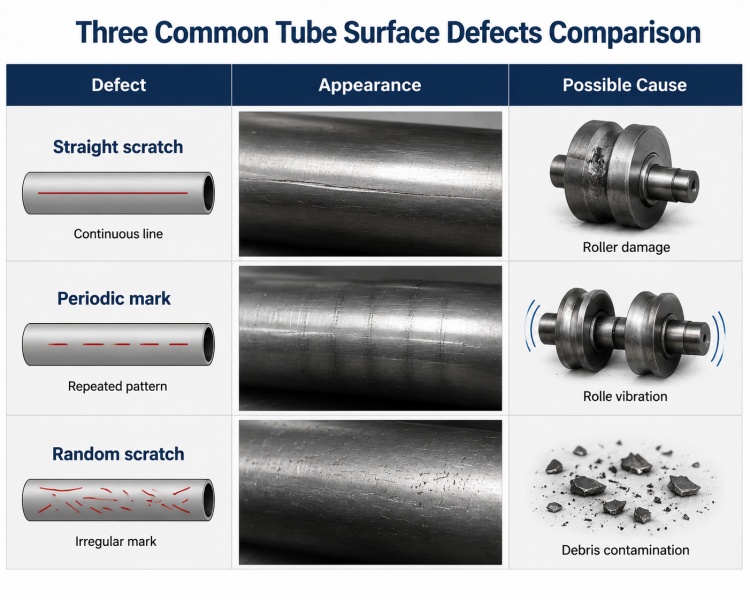
| Defect | Appearance | Possible Cause |
|---|---|---|
| Straight scratch | Continuous line | Roller damage |
| Periodic mark | Repeated pattern | Roll vibration |
| Random scratch | Irregular mark | Debris contamination |
Problem → Cause → Solution
Problem:
Finished tubes have visible scratches, reducing:
- Product value
- Customer acceptance
- Production yield
Causes:
Main causes include:
- Tube mill roller damage
- Incorrect roll pass design
- Poor roller polishing
- Excessive forming pressure
- Steel strip contamination
- Machine alignment problems
Solution:
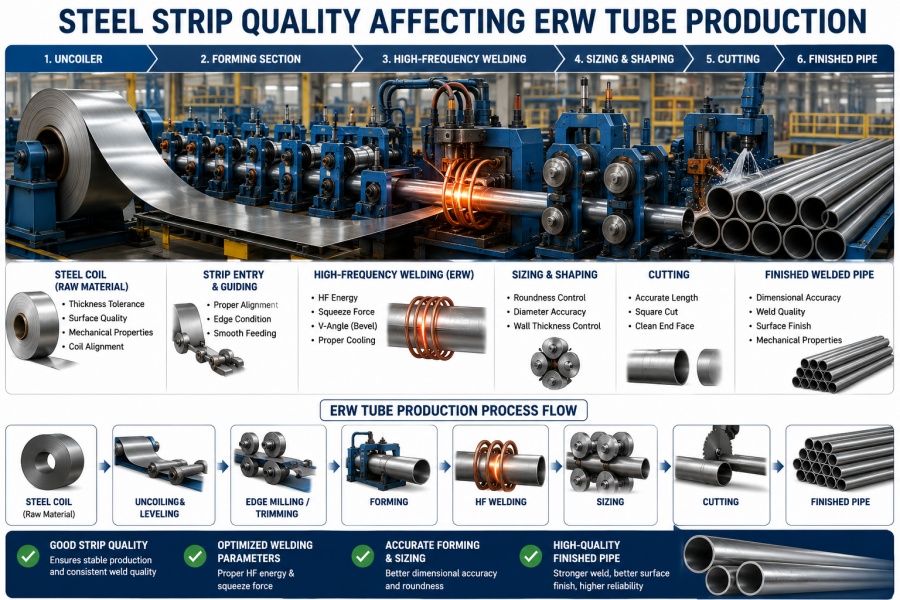
A complete inspection should follow the production sequence:
- Steel strip preparation
- Forming section
- High Frequency Welding section
- Sizing section
- Final inspection
Are Tube Surface Scratches Caused by Roller Design?
Problem
Many tube manufacturers ask:
"Should we improve the roller polishing, or redesign the rollers?"
The answer depends on the scratch pattern.
A polishing problem normally creates a local surface defect.
A roller design problem usually creates a continuous production problem.
For example:
If every pipe from the same production line has the same scratch position, the first inspection point should be the corresponding forming or sizing roller.
Cause 1: Incorrect Tube Mill Roll Pass Design
Problem
The main function of tube mill rollers is to gradually transform flat steel strip into a round tube.
A properly designed roll pass should control:
- Material deformation
- Contact pressure
- Strip movement
- Edge forming
However, an incorrect design can create excessive friction between the steel strip and rollers.
How Does Poor Roll Design Create Scratches?
During forming:
- Steel strip enters forming section
- Rollers apply pressure
- Strip gradually bends
- Tube shape is created
If the contact condition is incorrect:
- Pressure becomes concentrated
- Sliding increases
- Roller wear accelerates
- Surface damage appears
For example:
A roller with an unsuitable radius may create a small contact area.
The result:
- Higher pressure concentration
- Higher friction
- Surface scratches
Example:
A manufacturer produces decorative square tubes.
The original tooling was designed mainly for structural pipes.
After increasing production speed:
- Surface scratches appear
- Roller temperature increases
- More polishing is required
The root cause is not only polishing.
The tooling design does not match the production requirement.
Solution:
Optimize the roll pass design according to:
1. Tube specification
Different sizes require different tooling.
Examples:
- Round pipe
- Square tube
- Rectangle tube
- Stainless steel tube
A single universal roller design cannot provide the best surface quality for all products.
2. Material characteristics
Different materials behave differently:
Carbon steel:
- Easier forming
- Lower adhesion risk
Stainless steel:
- Higher work hardening
- Higher galling risk
Therefore, stainless steel tube production requires higher roller surface quality.
3. Production speed
Higher speed means:
- More friction
- More heat
- Faster wear
A tooling design suitable for 30 m/min production may not perform well at 120 m/min
How Does Tube Mill Roller Polishing Affect Surface Quality?
Problem
Many tube manufacturers believe:
"If the roller design is correct, surface scratches should disappear."
However, this is not always true.
Even a perfectly designed ERW Tube Mill can produce defective pipes if the roller surface condition is poor.
The reason is simple:
The roller is the direct contact point between the machine and the steel strip.
Any defect on the roller surface can be transferred directly to the tube surface.
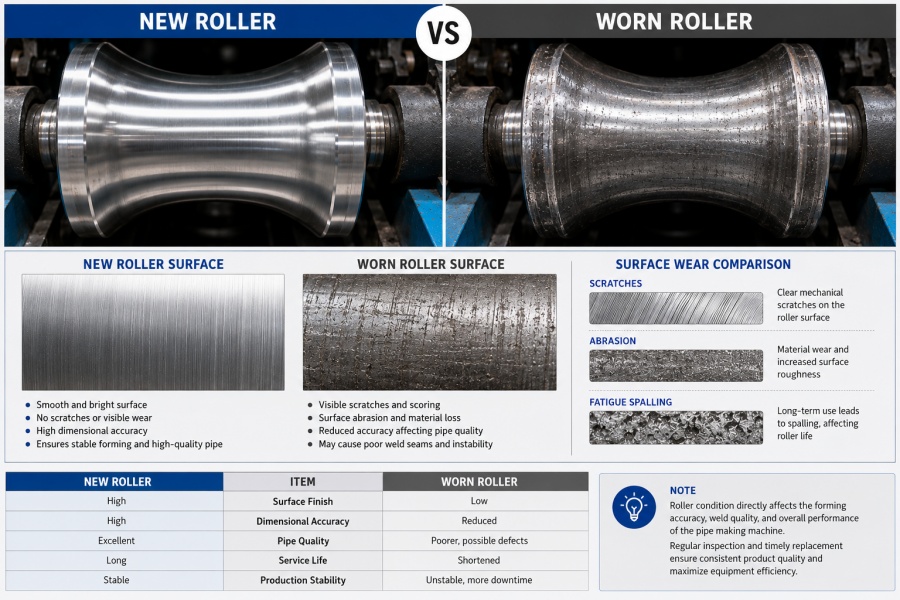
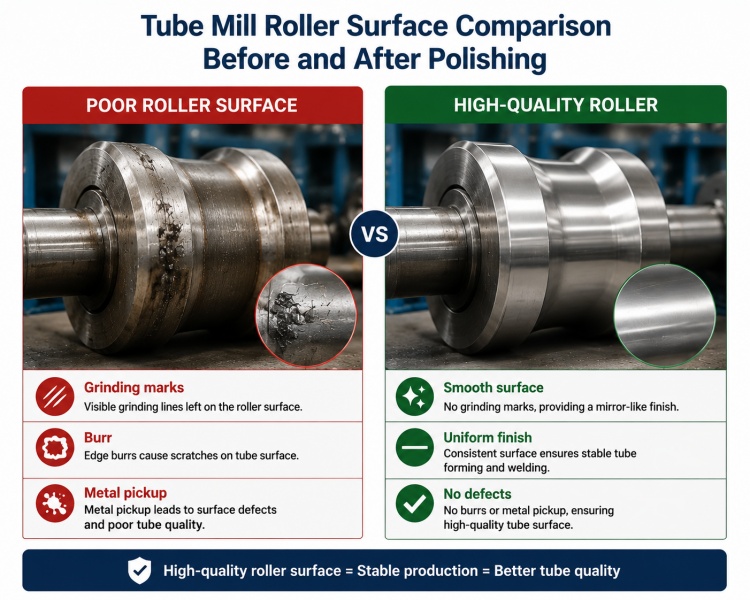
Common roller surface problems include:
- Grinding marks
- Deep grooves
- Rust spots
- Burrs
- Metal pickup
- Surface pitting
When the steel strip passes through the forming and sizing section, these defects become permanent marks on the finished pipe.
Roll manufacturers commonly identify grooves, scoring, galling, and pickup on roll surfaces as typical causes of tube surface defects.
Cause 1: Rough Roller Surface Finish
Problem
The polishing quality of tube mill rollers directly affects the appearance of the final product.
For normal structural pipes, small surface marks may be acceptable.
However, for:
- Furniture tubes
- Stainless steel decorative tubes
- Automotive tubes
- High-end precision tubes
even small scratches can lead to customer rejection.
A roller surface that looks acceptable visually may still contain:
- Micro scratches
- Grinding lines
- Uneven roughness
During production:
- Roll surface defect
- Steel strip contact
- Pressure amplification
- Scratch transferred to tube
example from Production
A factory produces stainless steel decorative tubes.
Production speed:
80 m/min
After several hours:
Operators notice:
- Bright longitudinal lines
- Repeated surface marks
- Increased rejection rate
Initial assumption:
"Raw material problem."
After inspection:
Steel strip quality:
Normal
Machine alignment:
Normal
Final finding:
Sizing roller had a damaged polishing surface.
The roller was repaired and the defect disappeared.
Solution
Improve Roller Finishing Quality
Before installing rollers, check:
1. Surface roughness
The roller surface should match:
- Material type
- Tube application
- Production speed
2. Edge condition
Sharp edges can create:
- Cutting marks
- Linear scratches
- Material deformation
3. Surface cleanliness
After polishing:
Remove:
- Grinding powder
- Abrasive particles
- Oil residue
Residual particles can create new defects during trial production.
Cause 2: Metal Pickup on Roller Surface
Problem
Metal pickup is one of the hidden causes of tube scratches.
During high-speed production, the steel strip and roller are under:
- Pressure
- Friction
- Heat
Under unstable conditions, small amounts of metal may stick to the roller surface.
This creates:
- A hard raised particle
- When the next tube passes:
- Metal pickup
- Mechanical scratching
- Continuous surface defect
Roll pickup and galling are recognized causes of longitudinal tube scratches, especially in applications where surface appearance is critical.
Why Does Metal Pickup Happen?
Cause 1:
Excessive forming pressure
Too much pressure causes:
- Higher friction
- More heat
- Faster roller wear
Cause 2:
Poor lubrication
Insufficient lubrication increases:
- Sliding resistance
- Adhesion
- Temperature
Cause 3:
Incorrect roller material
Different applications require different roller materials.
Common choices:
D2 Tool Steel
Advantages:
- High wear resistance
- Good hardness
Suitable for:
Carbon steel tubes
SKD11
Advantages:
- Excellent wear resistance
- Good dimensional stability
Suitable for:
Long production runs
H13
Advantages:
- Better thermal resistance
Suitable for:
High-temperature applications
Solution
Control:
- Roller material selection
- Cooling system
- Lubrication
- Production pressure
For high-speed ERW production lines, tooling selection should match:
- Tube size
- Steel grade
- Production speed
- Surface requirement
Hidden Causes of Tube Surface Scratches
Problem
Sometimes factories replace rollers but scratches remain.
Why?
Because the real cause may not be the roller itself.
The entire production system must be checked.
Cause 1: Steel Strip Surface Problems
Before entering the tube mill, the steel strip may already contain defects.
Examples:
- Rust
- Scratches
- Edge damage
- Metal particles
These defects can become more obvious after forming.
Especially when producing galvanized tubes:
Surface defects from raw material may affect final appearance.
Solution
Inspect incoming strip:
Check:
- Coil surface
- Edge condition
- Cleanliness
- Thickness consistency
A good tube production process starts before the strip enters the forming section.
Cause 2: Incorrect Roller Pressure Adjustment
Problem
Some operators try to solve dimensional problems by increasing roller pressure.
However:
More pressure ≠ Better quality
Excessive pressure can create:
- Surface scratches
- Roller wear
- Tube deformation
- Higher motor load
Example
A factory produces:
OD 50 mm × 2.0 mm wall thickness tube
Problem:
Tube diameter slightly oversized.
Operator adjustment:
Increase forming pressure.
Result:
Diameter improves.
But:
Surface scratches appear.
Why?
Because excessive pressure increased friction between:
Tube surface and Roller surface
Solution
Optimize:
- Roll gap
- Pass reduction
- Alignment
- Pressure distribution
The objective is:
Stable forming force
Minimum unnecessary friction
Cause 3: Machine Alignment Problems
Problem
Even high-quality rollers cannot perform correctly if the machine alignment is incorrect.
Common issues:
- Roll center deviation
- Uneven stand adjustment
- Bearing wear
- Guide misalignment
These problems create uneven contact pressure.
One side of the tube may experience:
- Higher pressure
- Higher friction
- Surface scratches
Solution
Regularly check:
Roller alignment
Confirm:
- Centerline accuracy
- Horizontal position
- Vertical position
- Bearing condition
- Worn bearings may create:
- Vibration
- Roll movement
- Repeated marks
Does High Frequency Welding Cause Tube Surface Scratches?
Problem
Some manufacturers think surface scratches near the weld area are caused only by rollers.
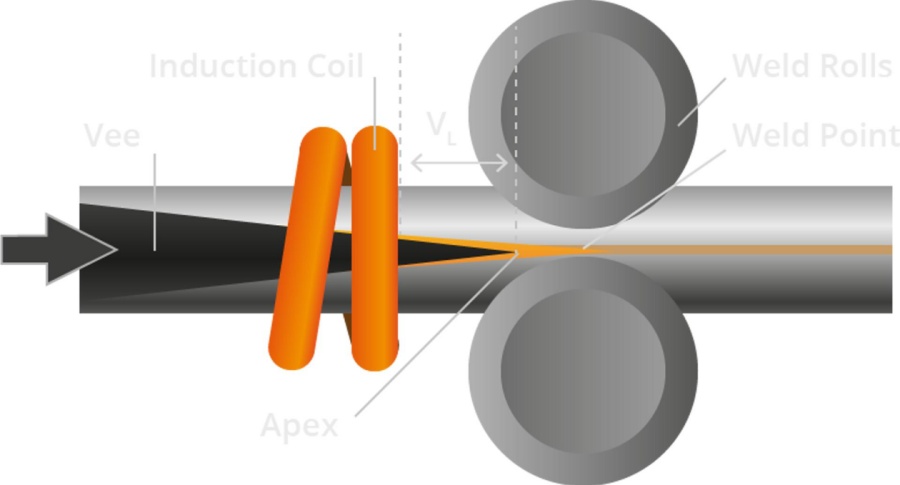
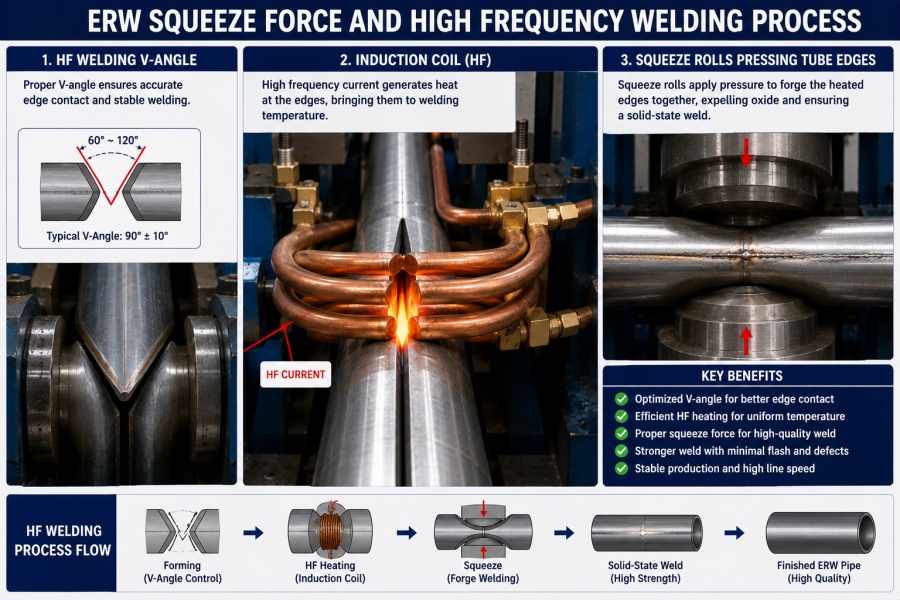
However, the High Frequency Welding Process can also influence surface appearance.
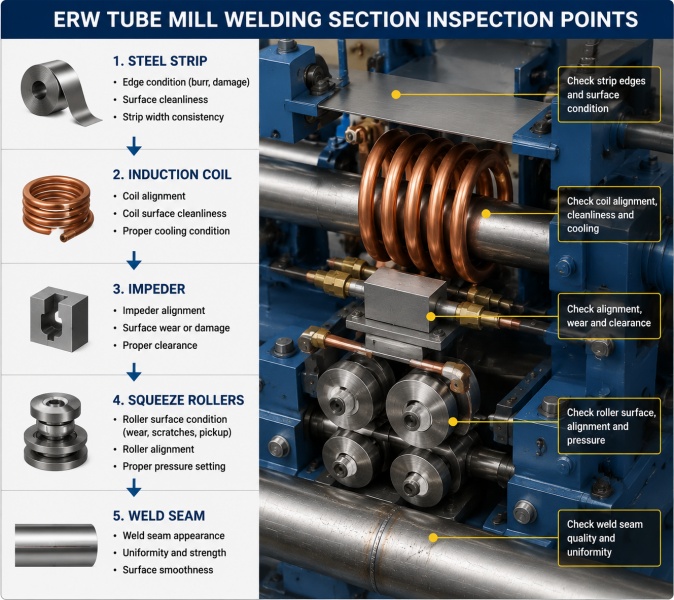
The welding section includes:
- Induction coil
- Impeder
- Squeeze rollers
Incorrect welding conditions may create:
- Weld seam marks
- Surface indentation
- Local deformation
Cause 1: Squeeze Roller Problems
The squeeze roller applies pressure during welding.
If adjustment is incorrect:
Possible defects:
- Linear indentation
- Weld area marks
- Uneven surface
Research on squeeze roller-related defects shows that incorrect roller position, excessive pressure, or alignment problems can create linear marks and surface defects on tube blanks.
Solution
Check:
- Squeeze roller center
- Roller gap
- Bearing condition
- Pressure setting
Improving High Frequency Welding Quality requires not only controlling welding power but also ensuring stable squeeze roller adjustment and proper mechanical alignment.
How to Diagnose Tube Surface Scratch Problems?
Problem
Many factories lose time because they repair the wrong component.
The correct approach is:
Identify the scratch pattern first.
Diagnosis Table
| Scratch Appearance | Possible Cause |
|---|---|
| Same position every pipe | Roller surface damage |
| Repeated distance marks | Roller vibration |
| Random scratches | Debris contamination |
| Weld area marks | Squeeze roller problem |
| Full batch defect | Raw material issue |
How to Permanently Prevent Tube Surface Scratches?
Problem
Many tube manufacturers solve surface scratches only after customers complain.
Typical reaction:
- Replace damaged roller
- Polish tooling
- Reduce production speed
- Adjust operators manually
However, these are temporary solutions.
A stable solution requires a preventive quality control system covering:
- Raw material
- Tube mill tooling
- Machine adjustment
- Welding process
- Maintenance management
Surface scratches in tube production are usually the result of multiple factors working together. Damaged roll surfaces, improper adjustment, foreign materials, and strip defects can all contribute to visible tube marks.
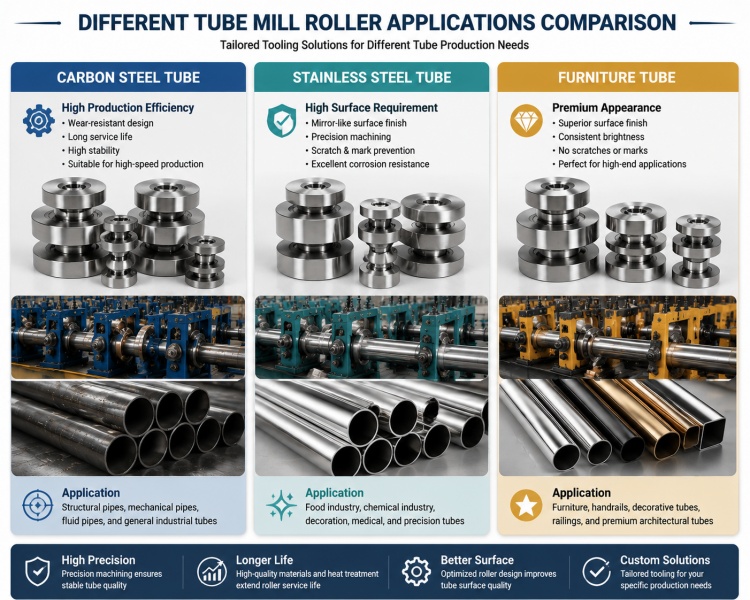
Solution 1: Select the Correct Tube Mill Tooling
Problem
Many factories focus only on machine capacity:
"Can this tube mill produce my required size?"
However, surface quality depends heavily on tooling accuracy.
The same machine may produce:
- Construction pipes
- Furniture tubes
- Decorative tubes
But each application requires different tooling solutions.
Cause
Incorrect tooling selection may create:
- Excessive forming pressure
- Unstable strip movement
- Uneven contact
- Higher roller wear
For example:
A roller design suitable for thick-wall structural pipes may not be ideal for thin-wall decorative tubes.
Solution
Choose tooling according to:
Tube Application
Structural tube:
Focus:
- Strength
- Productivity
Decorative tube:
Focus:
- Surface finish
- Appearance
Material
Carbon steel:
Normal wear requirements
Stainless steel:
Higher requirements:
- Surface hardness
- Polishing quality
- Anti-galling performance
Production Speed
Higher speed requires:
- Better roller accuracy
- Better cooling
- Better maintenance
Professional Tube Mill Tooling Solutions help manufacturers reduce surface defects by matching roll design, material selection, and production requirements.
Solution 2: Improve Tube Mill Maintenance System
Problem
A common mistake:
Factories maintain machines only when problems appear.
However, roller damage usually develops gradually.
Early signs include:
- Slight surface marks
- Increased noise
- Higher motor load
- Abnormal vibration
Cause
Without regular inspection:
- Small roller damage
- Continuous production
- Larger surface defect
- Batch rejection
Solution
Create a preventive maintenance schedule.
Daily Inspection
Check:
- Roller surface cleanliness
- Oil leakage
- Abnormal vibration
- Metal particles
Weekly Inspection
Check:
- Roller wear
- Bearing condition
- Roll gap
- Alignment
Monthly Inspection
Check:
- Tooling accuracy
- Surface roughness
- Machine centerline
A detailed Tube Mill Maintenance Guide allows operators to detect roller wear and alignment problems before they become expensive production losses.
olution 3: Improve High Frequency Welding Stability
Problem
Although many scratches originate from forming and sizing sections, defects near the weld area require special attention.
The welding section of an ERW Tube Mill includes:
- Induction coil
- Impeder
- V-angle
- Squeeze rollers
Unstable welding conditions may create:
- Weld seam marks
- Local indentation
- Surface deformation
Cause
Common welding-related surface problems:
Squeeze Roller Misalignment
Possible effects:
- Linear indentation
- Uneven weld pressure
Excessive Squeeze Force
Possible effects:
- Surface marking
- Tube deformation
Worn Bearings
Possible effects:
- Roller vibration
- Repeated marks
Squeeze roller position, gap, and bearing condition are important factors when diagnosing tube surface marks around the welding area.
Solution
Optimize:
- Squeeze roller adjustment
- Welding pressure
- Welding speed
- Machine alignment
Improving High Frequency Welding Quality requires controlling both electrical parameters and mechanical stability inside the welding section.
Final Troubleshooting Checklist for Tube Surface Scratches
| Inspection Item | Question | Possible Action |
|---|---|---|
| Scratch position | Same location every pipe? | Check roller |
| Scratch pattern | Continuous line? | Inspect roll surface |
| Production time | Appears after several hours? | Check roller wear |
| Tube section | Near weld area? | Check squeeze roller |
| Material | Different coil only? | Check steel strip |
| Machine speed | Only high speed problem? | Optimize tooling |
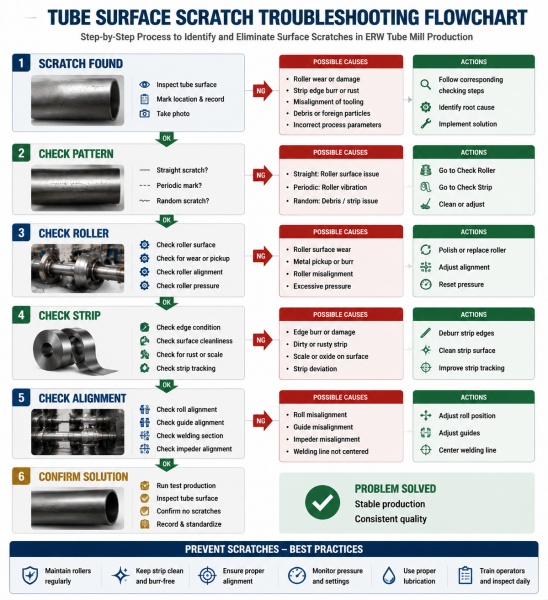
Tube Surface Scratch Prevention Workflow
Step 1
Check Raw Material
↓
Step 2
Inspect Tube Mill Rollers
↓
Step 3
Check Roll Pass Design
↓
Step 4
Adjust Forming Pressure
↓
Step 5
Inspect Welding Section
↓
Step 6
Verify Final Tube Quality
Conclusion
Tube surface scratches are not simply a polishing problem.
They are usually the result of interaction between:
- Tube mill roller design
- Roller surface quality
- Production parameters
- Steel strip condition
- Machine maintenance
For manufacturers producing high-value pipes, especially decorative tubes, stainless steel tubes, and precision welded pipes, controlling surface quality should start from the complete production system.
A reliable solution combines:
- Correct roll pass design
- High-quality tube mill rollers
- Proper polishing
- Stable High Frequency Welding
- Preventive maintenance
By identifying the real source of scratches, manufacturers can reduce rejection rates, improve production efficiency, and deliver higher-quality tubes to customers.
FAQ
Q1: Why do my ERW tubes have straight scratches?
Straight scratches usually indicate contact problems with forming or sizing rollers.
Possible causes:
- Damaged roller surface
- Metal pickup
- Incorrect roller adjustment
Q2: How can I know if scratches come from rollers?
Check whether the defect:
- Appears on every pipe
- Has the same position
- Has the same depth
If yes, inspect the corresponding roller first.
Q3: Can polishing solve tube surface scratches?
Polishing can solve minor roller surface problems.
However:
If the roll pass design is incorrect, polishing alone cannot eliminate scratches.
Q4: What roller material is best for ERW tube production?
Common materials include:
- D2
- SKD11
- H13
The best choice depends on:
- Tube material
- Production speed
- Surface requirement
Q5: How often should Tube Mill Rollers be replaced?
There is no fixed replacement period.
The replacement cycle depends on:
- Production volume
- Material hardness
- Maintenance quality
- Surface requirements
-
1. What is the material of the pipe that the machine produce
GI pipe, Steel pipe, Mild steel pipe, Low carbon steel pipe -
2. Is it possible to customize the equipment according to the demanding of the customer?
-
3. Do you have any certificates?
-
4. What is the payment method?
-
5. What does the after-service do you provide?
-
6. When will the engineer arrive?
-
7. How long will the installation and staff training?
-
8. Do you have reference project?
-
9. What about spare parts?