


 Tube Mill Consumables: Inspection & Replacement Guide


Why Are Your Pipe Forming Rollers Wearing Out So Fast?
Quick answer
Pipe forming rollers usually wear out too fast because of excessive forming pressure, incorrect roll gap, poor mill alignment, unsuitable roller material, inadequate lubrication, worn shafts or bearings, and poor strip condition. Before replacing the rollers, inspect the complete forming system to identify the actual cause.
If your pipe forming rollers wear out much faster than expected, replacing them may not solve the problem.
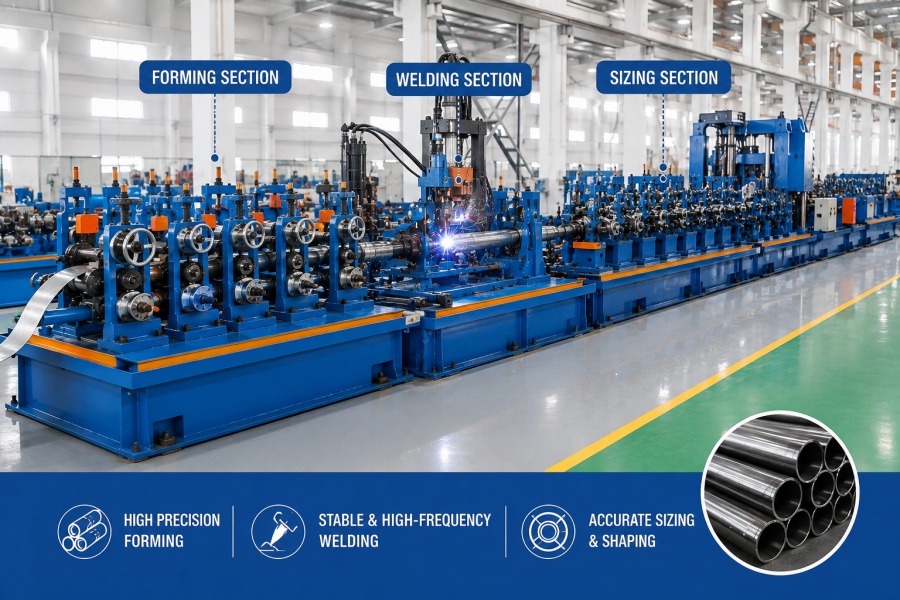
Fast roller wear is often caused by a combination of factors. Excessive roll pressure, poor mill alignment, worn shafts or bearings, unsuitable roller material, damaged roll surfaces, and unstable strip tracking can all shorten roller life.
The important question is not simply, “Why did the roller wear out?”
It is:
“What caused the roller to wear out so quickly?”
Finding that answer can help you avoid repeated roller replacement and unnecessary production downtime.
What Does Premature Pipe Forming Roller Wear Look Like?
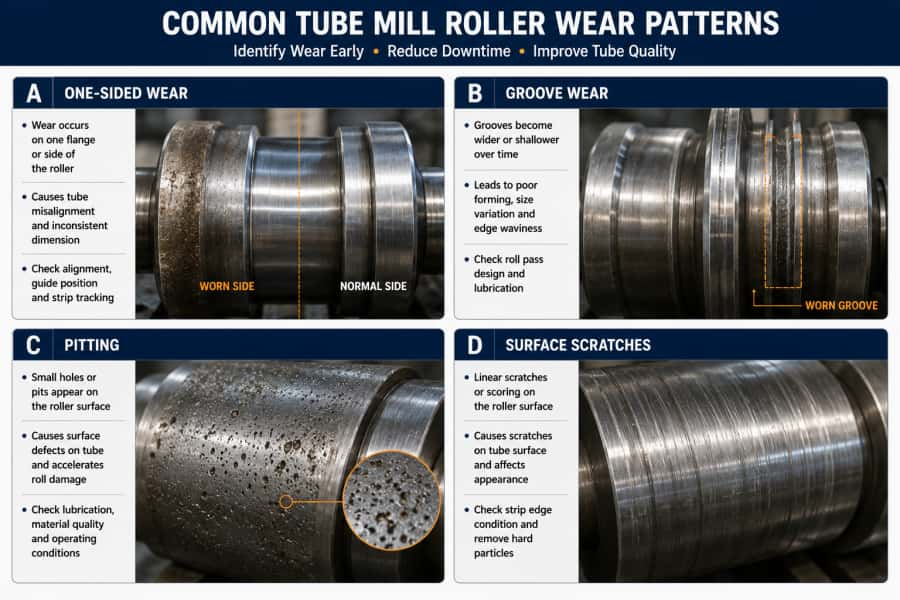
Before changing your rollers, look closely at the wear pattern.
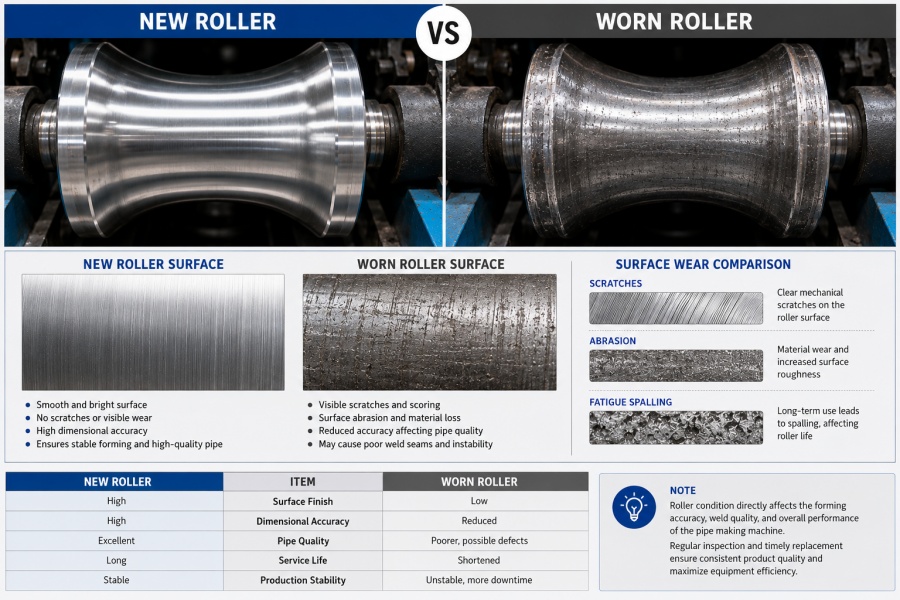
Different wear patterns often point to different problems. Tube mill roller lifespan
For example:
- One-sided wear may indicate roll or mill misalignment.
- Deep groove wear may be related to excessive forming pressure.
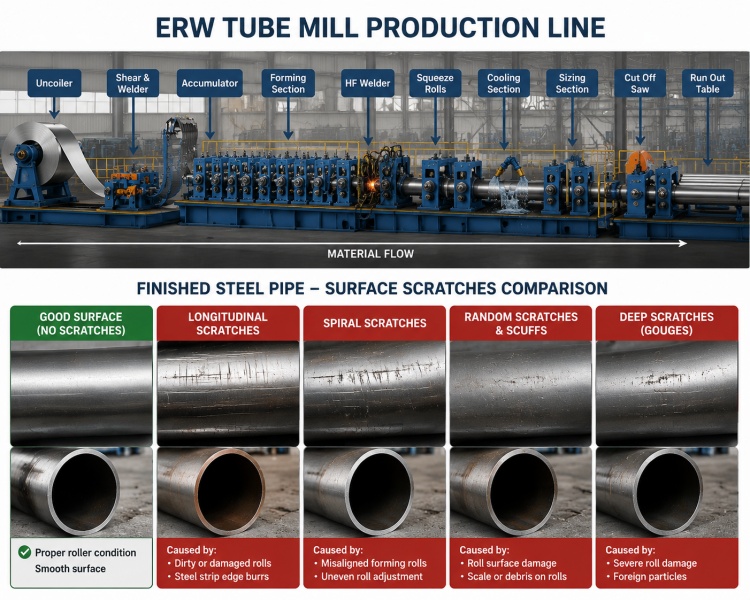
- Scratches on the tube surface may come from damaged or poorly finished roll surfaces.
- Pitting or local damage may indicate surface damage, contamination, or unsuitable roller conditions.
- Uneven wear between stands may indicate an incorrect setup or an uneven forming load.
- Changing tube dimensions may indicate worn roll profiles or incorrect roll gaps.
Recent tube mill troubleshooting cases also show that roller wear can be connected to machine alignment, shaft condition, bearings, tooling geometry, and production conditions—not just the roller itself.
So, don't start with a new roller order.
Start with a diagnosis.
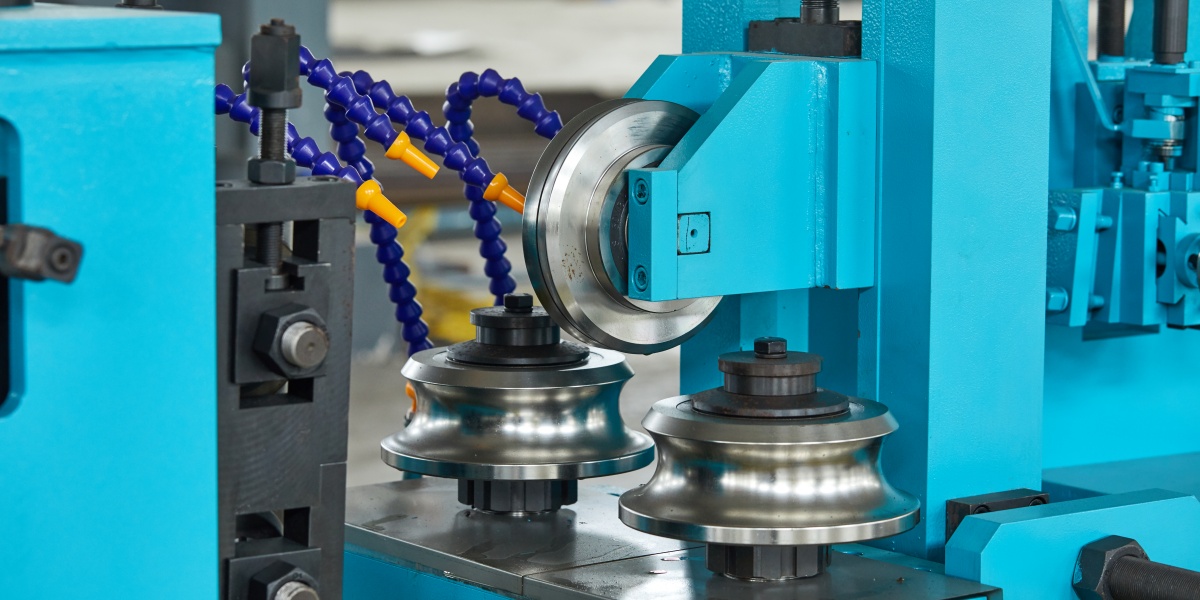
What Causes Pipe Forming Rollers to Wear Out So Fast?
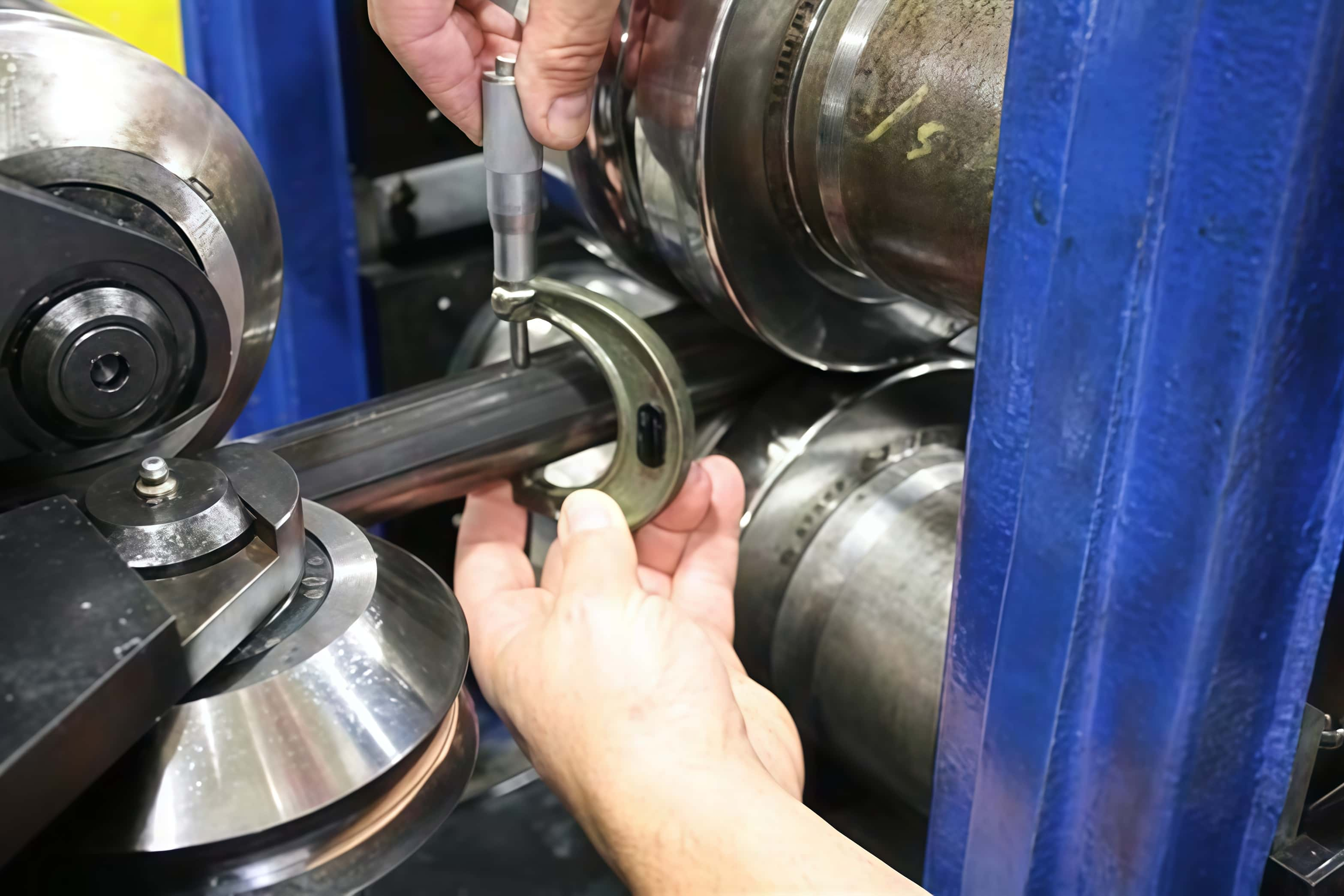
1. Is the Roll Gap Too Tight?
This is one of the first things to check.
When operators see an oversized or unstable tube, they may tighten the rollers to correct the dimension.
But more pressure does not always mean better forming.
If the roll gap is too tight, the strip is squeezed harder than necessary. This increases forming force and friction.
The result can be:
- Faster groove wear
- Higher motor load
- More heat
- Tube surface scratches
- Roller scoring
- Unnecessary deformation
On the other hand, a roll gap that is too loose can also create problems. The strip may move laterally, forming can become unstable, and the final tube dimension may become inconsistent.
The goal is not to make the rolls as tight as possible.
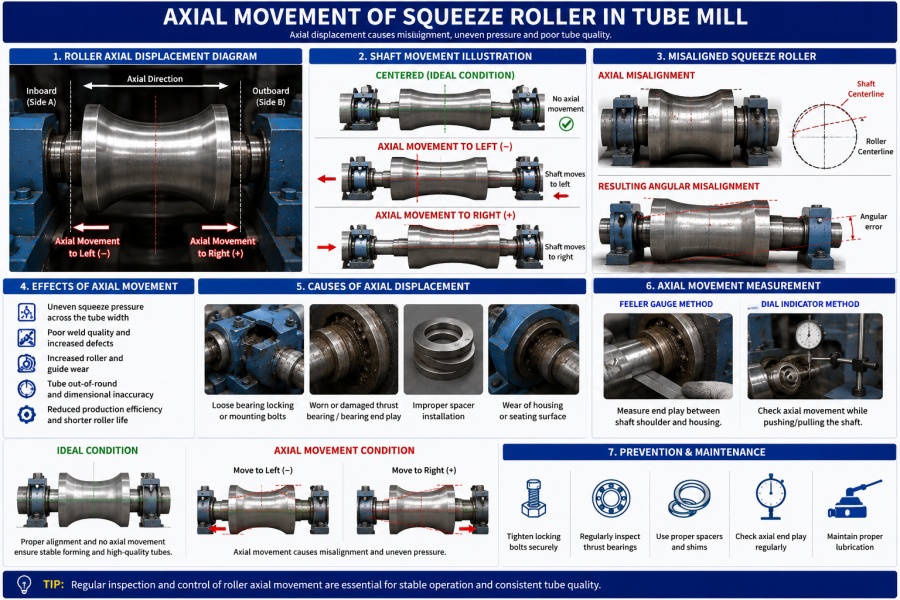
2. Is Your Tube Mill Properly Aligned?
A new set of rollers cannot fully compensate for a poorly aligned machine.
If the roll shafts, stands, guides, or pass line are not correctly aligned, the forming load may concentrate on one side of the roller.
This creates a familiar pattern:
One-sided roller wear is therefore an important warning sign.
Check:
- Roll shaft alignment
- Stand position
- Pass line
- Upper and lower roll parallelism
- Entry guide alignment
- Side pass positioning
Roll-Kraft's tube mill field experience also shows that poor alignment can contribute to premature tooling wear and product defects. Regular alignment checks are recommended rather than waiting until the line develops serious production problems.
3. Are the Shafts or Bearings Already Worn?
Sometimes the roller is blamed for a problem that actually starts with the machine.
A worn shaft can create excessive clearance between the shaft and roller.
A worn bearing can allow unwanted movement during operation.
Both conditions can affect roller positioning and load distribution.
Look for:
- Shaft wear
- Bearing looseness
- Excessive runout
- Damaged keyways
- Vibration
- Abnormal noise
If a new roller set starts showing the same abnormal wear pattern soon after installation, inspect the shafts and bearings before ordering another set.
Field inspections have found undersized shafts, loose bearing components, and worn tooling working together to create inconsistent tube forming and premature wear.
Can the Steel Strip Cause Roller Wear?
Yes.
The material entering the tube mill matters.
Different steel grades, thicknesses, hardness levels, surface conditions, and production speeds place different loads on the forming rolls.
Problems can also start with the strip itself.
For example:
- Poor strip tracking
- Damaged strip edges
- Excessive burrs
- Surface contamination
- Inconsistent thickness
- Higher-strength steel than the original setup was designed for
If the strip enters the mill incorrectly, the rollers may not carry the load evenly.
This is why roller troubleshooting should include both the tooling and the incoming material.
In one tube mill field case, strip camber and unstable payoff contributed to downstream forming and tooling problems. The issue was not simply a worn roll set.
Can Poor Roller Surface Finish Cause Fast Wear?
It can.
A damaged roll surface can create friction and leave repeated marks on the tube.
If material sticks to the groove, even a small buildup can become a recurring surface defect.
This is especially important when producing tubes where surface appearance matters.
Check the roller for:
- Scratches
- Pitting
- Cracks
- Material buildup
- Rough areas
- Damaged edges
- Uneven polishing
If your pipe has longitudinal scratches and the roller shows corresponding damage, inspect that pass first. Why Are ERW Pipes Scratched After Production?
Don't automatically replace the entire roll set.
How Do You Troubleshoot Tube Mill Roller Wear?
A simple troubleshooting sequence can save time.
Step 1: Identify the wear pattern.
Is the wear even or concentrated on one side?
Step 2: Inspect the roll surface.
Look for scratches, buildup, cracks, or abnormal polishing.
Step 3: Check the roll gap.
Make sure excessive pressure is not being used to compensate for dimensional problems.
Step 4: Check machine alignment.
Inspect the pass line, shafts, stands, guides, and roll parallelism.
Step 5: Check shafts and bearings.
Look for clearance, runout, vibration, or mechanical damage.
Step 6: Review the production material.
Confirm steel grade, thickness, strip width, surface condition, and tracking.
Step 7: Check the roller design and material.
If the machine and process are correct but the roller still wears too quickly, the roll design, material, hardness, or heat treatment may need to be reviewed.
Should You Replace the Rollers or Fix the Machine First?
It depends on the cause.
If the groove is seriously worn, cracked, or the roller profile has gone out of tolerance, replacement may be necessary.
But if the same roller wear appears again after replacement, stop and investigate the machine.
A useful rule is:
This approach prevents factories from repeatedly buying replacement tooling without fixing the underlying cause.
How Can MIVI Help Reduce Tube Mill Roller Wear?
At MIVI, roller selection starts with the actual production requirements.
We consider factors such as:
- Tube diameter
- Round, square, or rectangular tube
- Wall thickness
- Steel grade
- Production speed
- Existing tube mill structure
- Required roller profile
For existing tube mills, custom rollers can also be designed according to the machine's shaft dimensions, roll arrangement, forming requirements, and existing production conditions.
The objective is not simply to manufacture a harder roller.
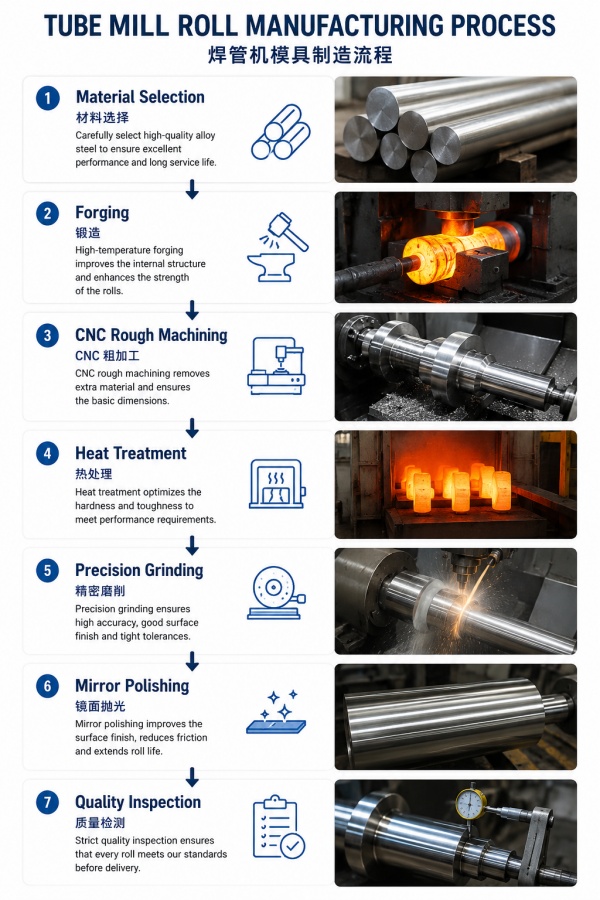
Proper roll design, suitable material and heat treatment, accurate machining, and correct installation all contribute to longer roller service life.
Final Takeaway
When pipe forming rollers wear out too fast, don't assume the roller itself is always the problem.
Check the entire system:
A worn roller is often a symptom.
The real cause may be excessive pressure, misalignment, poor strip tracking, mechanical wear, or an unsuitable roll design.
If you are experiencing rapid tube mill roller wear, send MIVI your tube size, material, wall thickness, production speed, existing roll drawing, or photos of the worn rollers. This information can help determine whether the problem is related to the roller design, machine condition, or forming process.
custom tube mill rollers for existing machines
1. Why do pipe forming rollers wear out so fast?
Pipe forming rollers can wear out quickly because of excessive forming pressure, incorrect roll gap, poor mill alignment, worn shafts or bearings, unsuitable roller material, poor lubrication, and unstable strip tracking. The roller itself is not always the root cause. Before replacing it, inspect the complete forming system.
2. How do I know if my tube mill rollers are wearing abnormally?
Look for uneven groove wear, one-sided wear, scratches, pitting, surface damage, or changes in the roller profile. If the same area of the tube develops repeated marks, inspect the corresponding roller. One-sided roller wear can also indicate alignment or load-distribution problems.
3. Can an incorrect roll gap cause premature roller wear?
Yes. A roll gap that is too tight increases forming force and friction. This can accelerate groove wear, scoring, and surface damage. A gap that is too loose can cause unstable strip tracking and forming problems. The correct setting depends on the tube material, wall thickness, roll design, and mill configuration.
4. Can poor tube mill alignment damage forming rollers?
Yes. Misalignment can concentrate the forming load on one side of the roller. This often produces uneven wear and can also affect tube dimensions and surface quality. If new rollers develop the same one-sided wear shortly after installation, check the mill alignment, shafts, bearings, and pass line before replacing the rollers again.
5. Can the steel strip affect tube mill roller life?
Yes. Steel grade, thickness, hardness, surface condition, edge quality, and strip tracking can all affect roller life. High-strength materials may require different forming conditions from standard carbon steel. Poor strip tracking or damaged edges can also create uneven loading and accelerate roller wear.
6. Does roller material affect service life?
Yes. Roller material and heat treatment directly affect wear resistance, toughness, surface stability, and profile retention. There is no single roller material that is best for every application. The selection should consider tube material, wall thickness, production speed, forming load, surface requirements, and expected production volume. MIVI supplies custom tube mill rollers for carbon steel, stainless steel, galvanized steel, and high-strength steel applications.
7. Should I replace the tube mill rollers or fix the machine first?
If the roller profile is severely worn, cracked, or outside the required tolerance, replacement may be necessary. However, if the same abnormal wear appears again after installing new rollers, investigate the machine first. Check alignment, roll gap, shafts, bearings, strip tracking, and forming conditions. Replacing rollers without fixing the root cause can lead to the same problem again.
8. Can damaged roller surfaces cause scratches on the pipe?
Yes. Scratches, grooves, metal pickup, pitting, and rough roller surfaces can transfer defects directly to the tube. If a scratch appears in the same position on every tube, inspect the forming or sizing roller at that position first. Minor surface problems may sometimes be corrected by polishing, but polishing cannot solve an incorrect roll design or machine setup.
9. How can I extend the life of pipe forming rollers?
Start with correct roll design and suitable roller material. Then maintain proper roll gap, shaft alignment, lubrication, cooling, and strip tracking. Regularly inspect the roller surface, shafts, bearings, and keyways. Avoid using excessive forming pressure to compensate for dimensional or alignment problems. A preventive maintenance approach is usually more effective than waiting until the rollers are severely damaged.
10. Can MIVI customize tube mill rollers for an existing machine?
Yes. MIVI can design custom tube mill rollers according to the existing machine structure and production requirements. The design can consider tube diameter, tube shape, wall thickness, steel grade, production speed, shaft dimensions, roll arrangement, and forming requirements. Custom rollers are available for round, square, rectangular, and special-shaped tubes.