


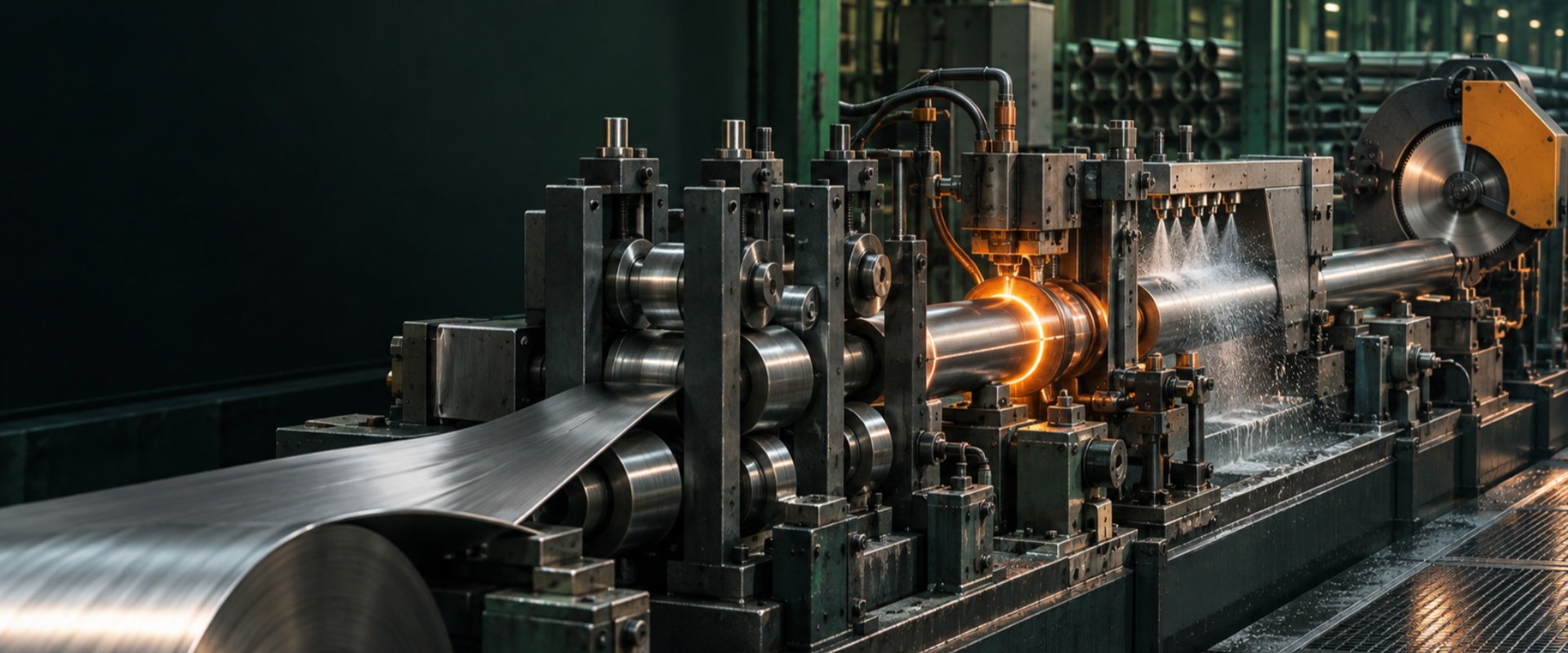
 Tube Mill Consumables: Inspection & Replacement Guide


Tube Mill Consumables: What Should You Monitor Before Production Problems Start?
A tube mill rarely stops without warning.
Before a ferrite rod fails, welding efficiency may begin to fall. Before a saw blade breaks, the cut becomes rougher and the machine sounds different. Before an induction coil causes an obvious welding problem, operators may notice unstable current, local heating or small arc marks.
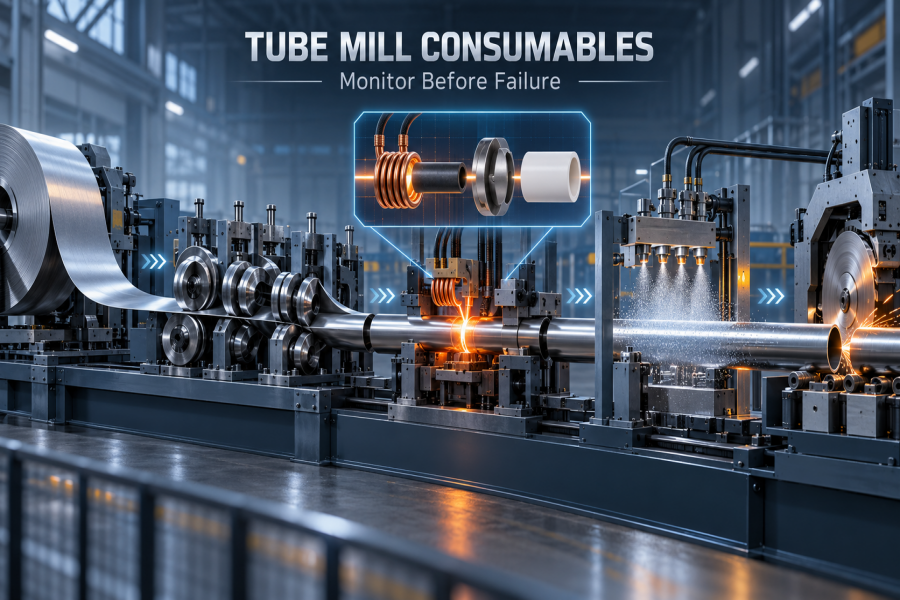
These early signs are easy to miss because the line is still running. The tube still comes off the mill, and the component does not look completely damaged.
That is exactly when inspection matters most.
Quick Answer: What Consumables Need to Be Checked on an ERW Tube Mill?
The main tube mill consumables that require regular inspection are:
- Ferrite rods
- PTFE tubes
- Impeders
- Induction coils
- Zinc spray gun components
- Scarfing inserts
- Saw blades
Operators should check them for physical wear, heat damage, contamination, cooling problems and changes in production performance. A component should not be kept in service simply because it has not broken. When it begins to increase welding power, create an unstable seam, produce an uneven zinc coating or leave excessive cutting burrs, replacement may already be justified.
The purpose of a tube mill consumables checklist is not to replace every part on a fixed date. It is to catch performance loss before it turns into scrap or unplanned downtime.
Why Should Tube Mill Consumables Be Monitored Before They Fail?
A broken component is easy to identify. A worn component is more difficult.
It may continue to work while quietly changing the process around it. The operator compensates by increasing HF power, adjusting squeeze pressure, reducing line speed or changing the saw feed. Production continues, but the original problem remains.
This creates a familiar situation in many ERW pipe factories: one small consumable begins to wear, several machine settings are changed to compensate, and the line becomes increasingly difficult to control.
The cost is not limited to the replacement part. It can also include:
- Unstable weld quality
- Higher power consumption
- Reduced production speed
- More burrs or poor cut faces
- Additional setup time
- Increased scrap
- Damage to nearby components
- An unexpected production stop
Good consumable management begins before visible failure. It connects inspection results with what is happening on the line.
Which Tube Mill Consumables Need the Most Attention?
Different areas of an ERW tube mill show wear in different ways.
| Consumable | What to inspect | Early production warning | Possible consequence |
| Ferrite rod | Cracks, missing pieces, discoloration and heat damage | HF power gradually increases | Poor welding efficiency or an unstable weld seam |
| PTFE tube | Wear, deformation, blockage and leakage | Cooling flow becomes weak or irregular | Ferrite overheating and shortened impeder life |
| Impeder | Position, casing wear, cooling and internal condition | Power demand or weld temperature becomes inconsistent | Weak fusion, overheating or reduced line speed |
| Induction coil | Shape, spacing, insulation, copper surface and cooling | Arcing, local heating or unstable current | Irregular heating and coil failure |
| Zinc spray components | Nozzle, wire guide, contact parts and feed rollers | Spray becomes intermittent or uneven | Incomplete weld-seam coating |
| Scarfing insert | Cutting edge, chipping and holder stability | Weld bead is not removed evenly | Poor pipe surface and inconsistent bead removal |
| Saw blade | Tooth wear, chipping, runout and heat marks | Burrs, noise or cutting load increases | Rough ends, inaccurate length or blade breakage |
This table is a starting point. The actual inspection frequency should reflect the tube size, wall thickness, steel grade, mill speed and number of production hours.
A line producing thick-wall pipe at high speed will not consume parts at the same rate as a line running light-gauge furniture tube for one shift per day.
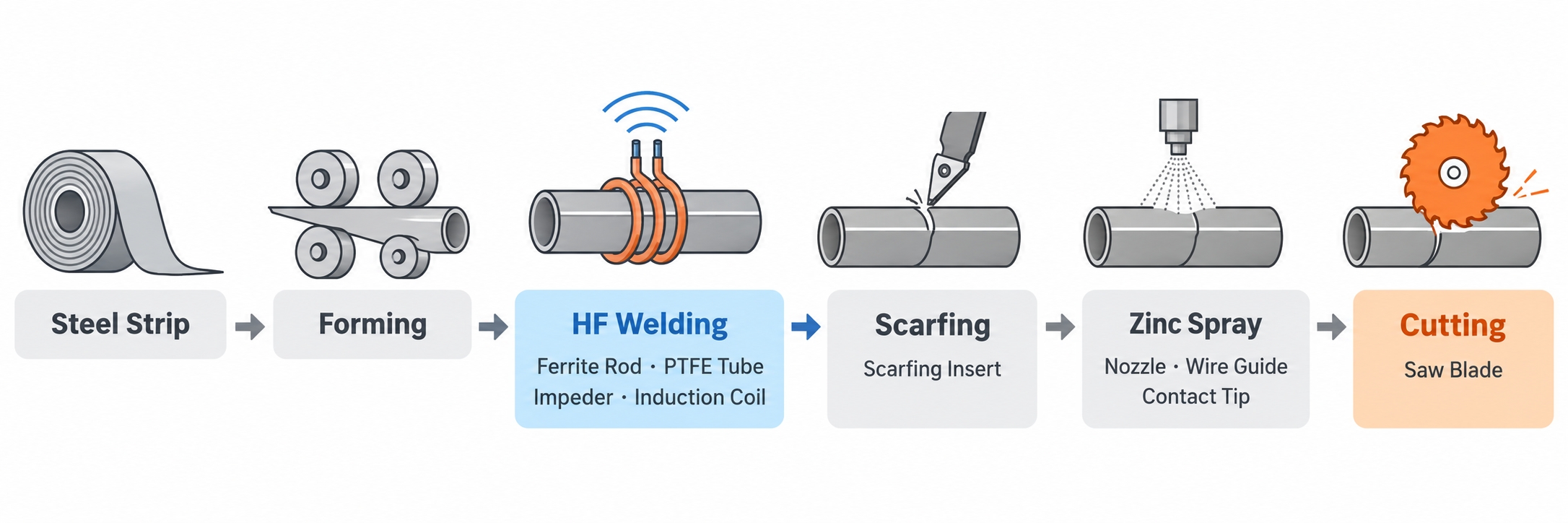
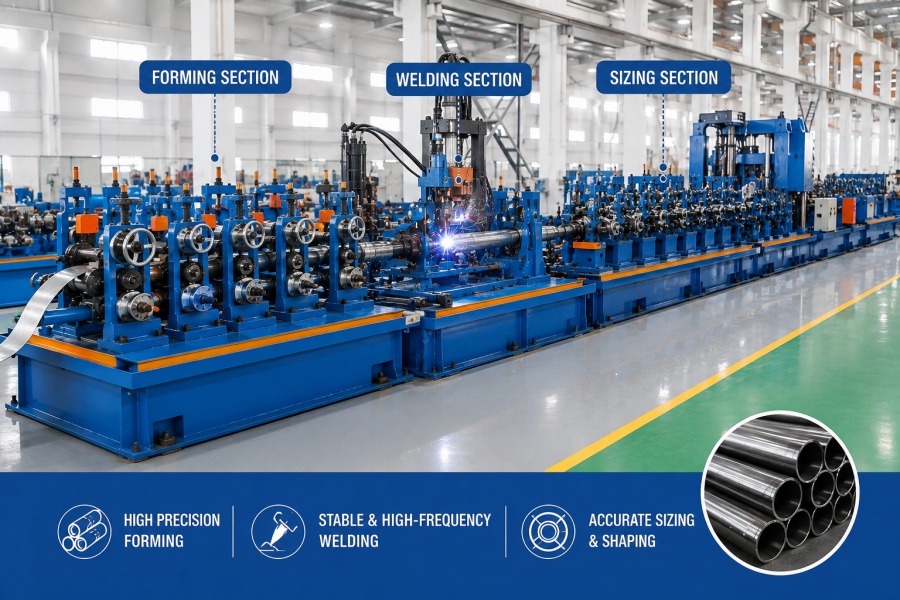
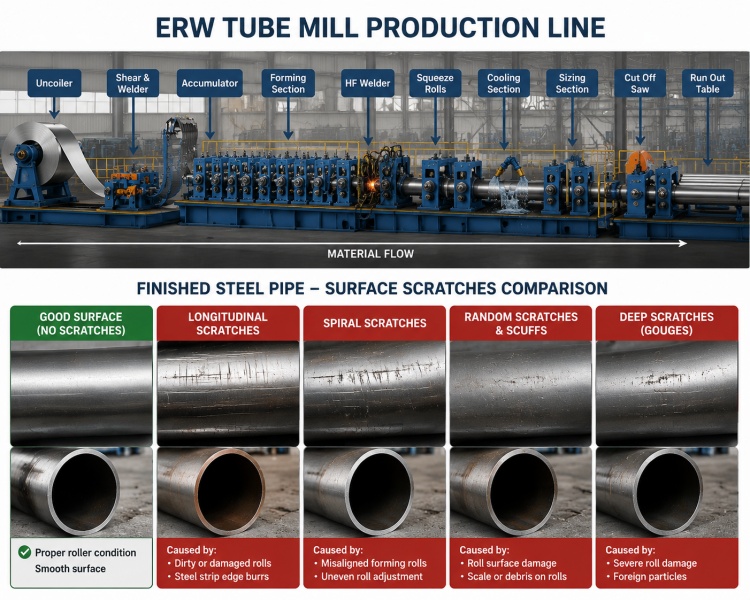
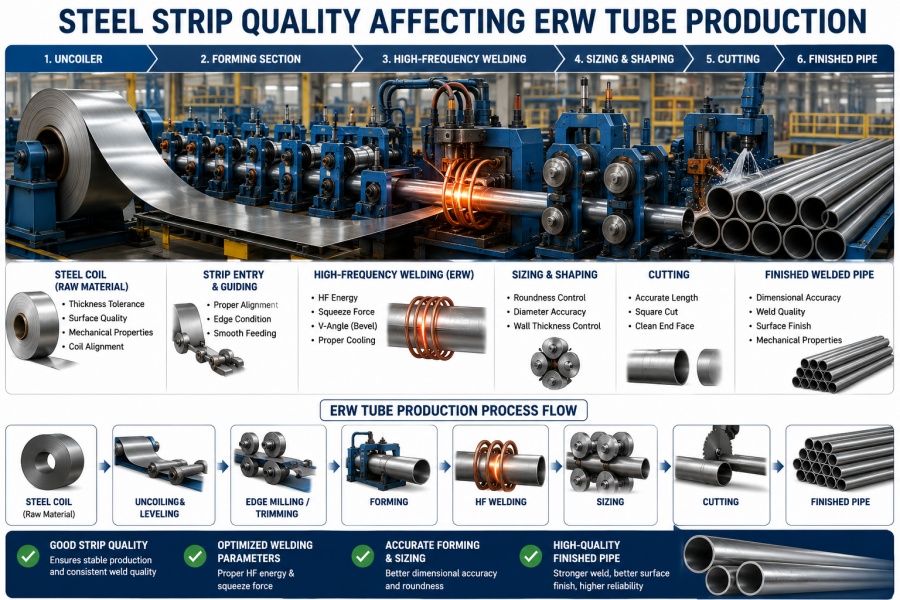
The main consumables are concentrated around the HF welding, weld-seam treatment and cutting sections.
What Should You Check on a Ferrite Rod?
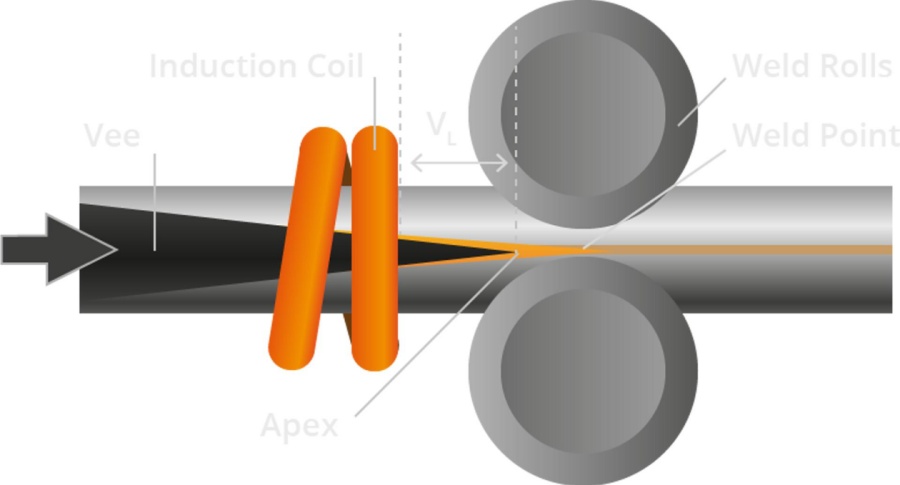
A ferrite rod helps concentrate the high-frequency current around the weld vee. Its condition has a direct effect on welding efficiency.
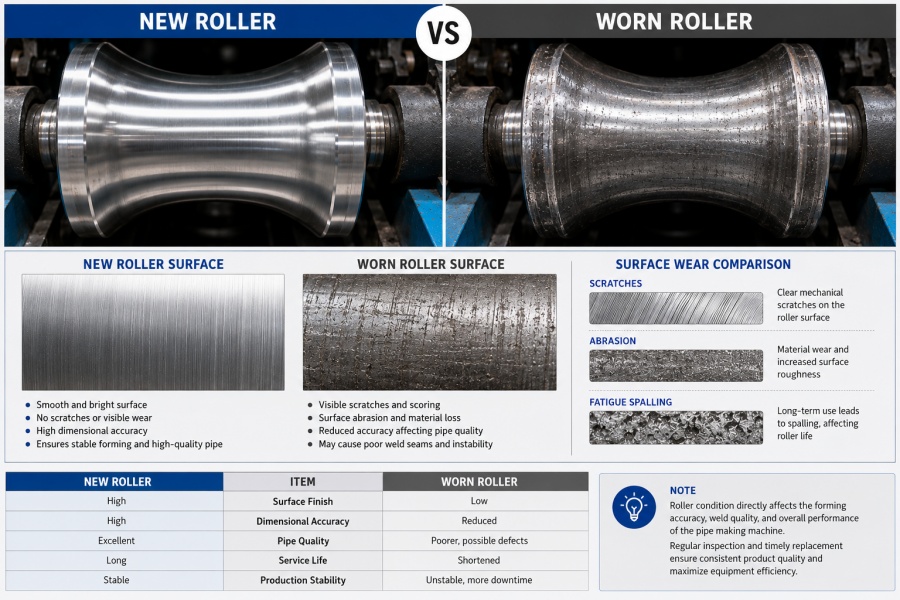
A damaged ferrite does not always cause the seam to open immediately. The first clue is often a gradual rise in required welding power. Operators may also see a narrower adjustment window: a small speed or power change suddenly produces underheating or overheating.
During inspection, look for:
- Cracks along the ferrite body
- Broken or missing sections
- Dark areas caused by excessive heat
- Mechanical impact damage
- Contamination around the ferrite pieces
- Incorrect ferrite length or diameter
- Poor cooling through the impeder assembly
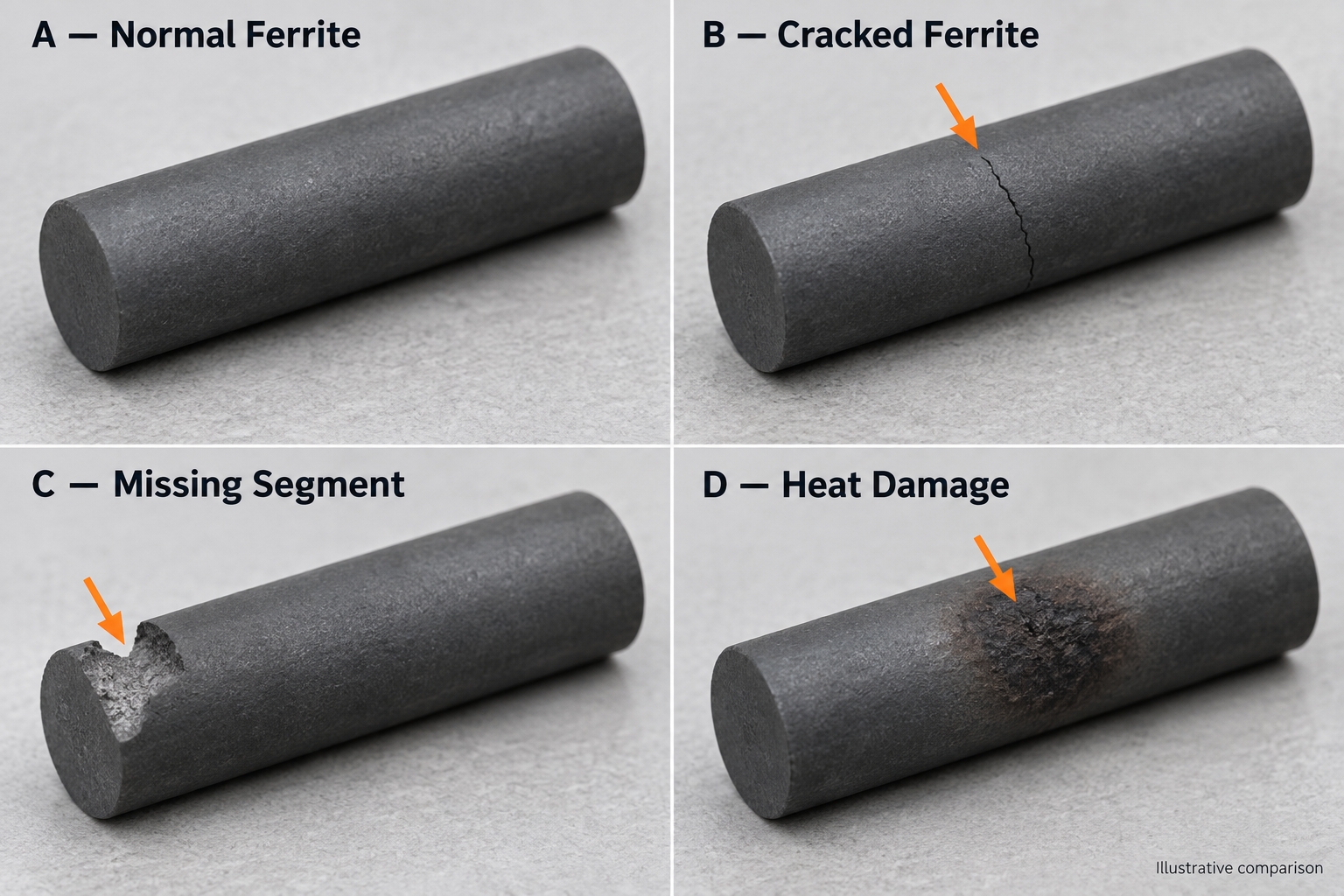
Cracks, missing sections and heat discoloration can appear before a ferrite causes complete welding failure.
Pay particular attention after an impeder has been removed, dropped or reassembled. Ferrite is brittle. Damage may occur during handling even if the mill has not yet returned to production.
The choice of ferrite also matters. A rod that does not match the tube diameter, operating frequency or impeder design may increase power demand even when it is new.
For specifications and available configurations, see MIVI’s hollow ferrite rod for high-frequency welding.
When Should a PTFE Tube Be Replaced?
The PTFE tube is easy to overlook because most of it is hidden inside the welding area. It protects and supports the ferrite while carrying cooling water through the impeder assembly.
Its condition should be checked whenever the impeder is removed.
Common problems include:
- A worn or thin tube wall
- Local deformation
- A blocked cooling passage
- A loose connection
- Water leakage
- Scale or dirt inside the tube
- Damage caused by friction against the moving pipe
Do not wait for a complete leak. A partial blockage may be enough to raise the ferrite temperature and reduce welding efficiency.
If the PTFE tube has lost its original shape, no longer holds the ferrite securely or cannot maintain steady cooling flow, replacement is usually safer than continued use.
The replacement tube must also match the impeder design. Outside diameter, inside diameter, length and connection method should be confirmed before ordering. “Almost the same size” is not a reliable specification in an HF welding zone.
You can view related PTFE tubes and ERW tube mill accessories in the MIVI accessories section.
How Do You Know an Impeder Is Losing Performance?
An impeder is an assembly, not just a ferrite rod.
Its performance depends on ferrite condition, casing integrity, position and cooling. Replacing only the ferrite will not solve the problem if the cooling passage is restricted or the impeder is installed too far from the weld point.
Check the following before production:
- Is the impeder straight and mechanically secure?
- Is it positioned correctly relative to the induction coil and weld vee?
- Is cooling water entering and leaving without restriction?
- Is the casing worn, cracked or deformed?
- Are the ferrite pieces packed and supported correctly?
- Has the power requirement changed compared with the last stable production run?
Temperature deserves special attention. Ferrite performance changes as temperature rises, which is why cooling is central to impeder life and welding efficiency.
Do not judge the impeder by appearance alone. Compare current power, production speed and cooling conditions with records from a stable run of the same tube specification.
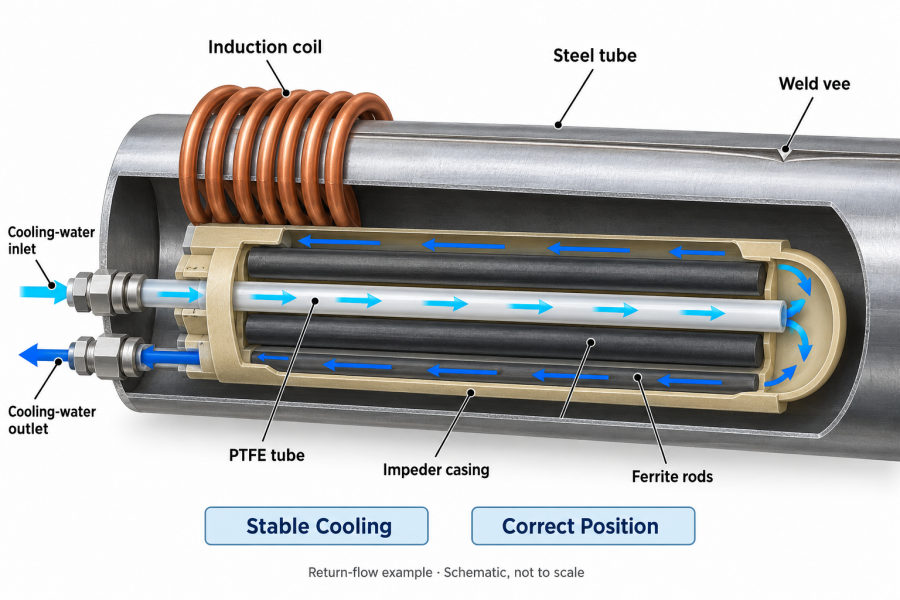
Impeder performance depends on ferrite condition, installation position and unrestricted cooling—not on the ferrite alone.
What Damage Should You Look for on an Induction Coil?
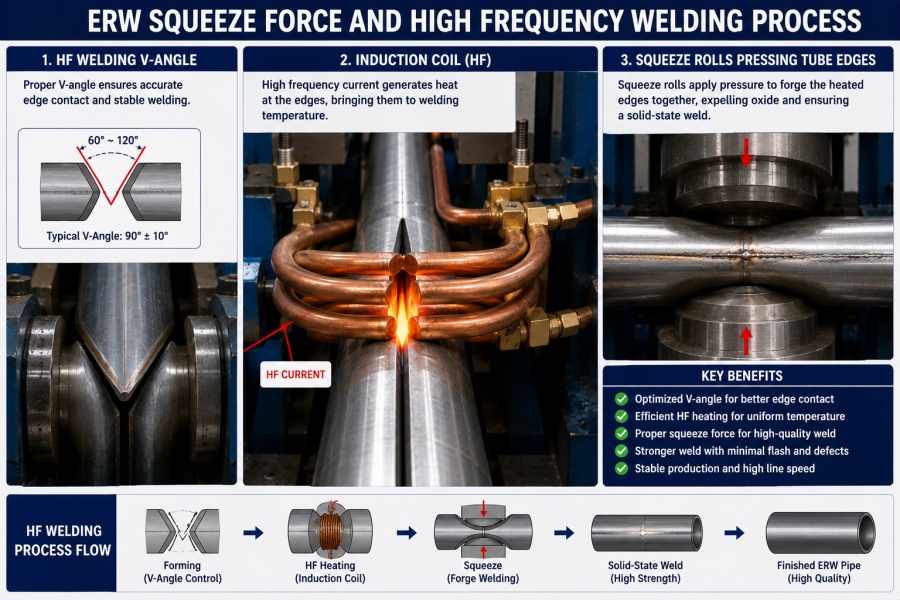
An induction coil works close to a hot, wet and electrically demanding process. Small changes in its shape or insulation can affect how evenly energy is delivered to the strip edges.
Before starting the line, inspect:
- Coil shape and symmetry
- Distance between the coil and tube
- Distance from the coil to the weld point
- Damaged insulation
- Burn marks or arc marks
- Loose electrical connections
- Cooling-water leakage
- Scale inside the cooling passage
- Copper erosion or deformation
A coil should not be reshaped casually on the mill. Even if it still fits around the tube, an uneven gap can change the heating pattern.
If repeated arcing occurs, stop and find the cause. Simply cleaning the burn mark and restarting the line may allow more serious damage to develop.
An induction coil should be replaced or repaired when it cannot maintain its designed geometry, reliable insulation or unrestricted cooling. Its dimensions should match the tube range and welding setup rather than being selected only by the pipe’s outside diameter.
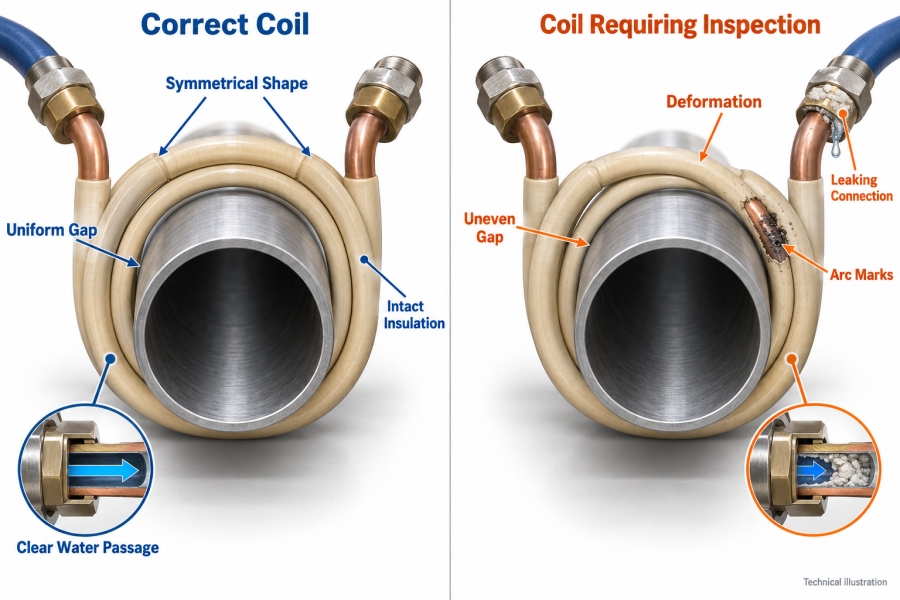
A coil may still fit around the tube even when deformation or insulation damage has already changed its performance.
Which Zinc Spray Components Wear Out First?
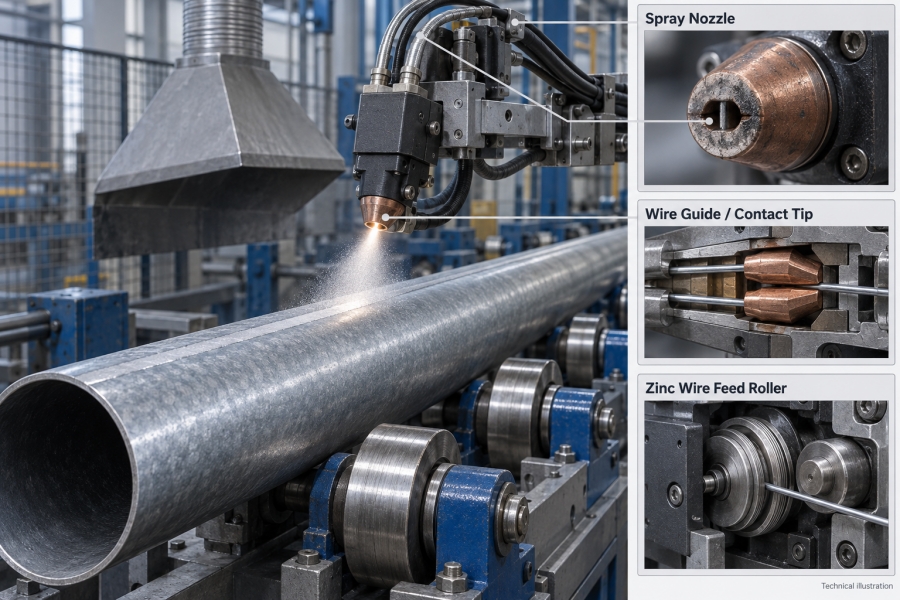
On a galvanized ERW tube line, the external weld bead removes the original zinc coating around the seam. A zinc spray system restores protection to this exposed area.
The complete spray gun may remain usable for a long time, but several smaller parts require attention:
- Spray nozzle
- Zinc wire guide
- Wire feed rollers
- Contact tip
- Air cap
- Cable and electrical connections
- Hose connections
- Cooling components, where fitted
A partially blocked nozzle often creates an uneven spray before it stops completely. Worn feed rollers may cause slipping, interrupted wire movement or irregular deposition. Dirt around the wire path can also make a mechanical problem look like an electrical one.
Inspect the coating on the pipe rather than watching only the spray gun. A narrow, intermittent or off-centre zinc layer is already a maintenance signal.
MIVI supplies zinc spray guns for ERW tube mill weld-seam protection as well as related replacement components
When Should a Tube Mill Saw Blade Be Replaced?
A saw blade does not need to lose a tooth before it becomes unsuitable for production.
The condition of the finished pipe end often gives an earlier warning. Look for increasing burr height, a rough cutting face, heat discoloration, inaccurate length or a cut that is no longer square.
Changes in sound and load also matter. A blade approaching the end of its useful life may produce:
- Higher cutting noise
- Increased motor load
- More vibration
- A longer cutting cycle
- Excessive heat
- Chipped or rounded teeth
- A cut that pulls to one side
Before blaming the blade, check the complete cutting system. Incorrect clamping, spindle runout, unsuitable feed speed, poor synchronization or inadequate lubrication can destroy a new blade quickly.
If several blades develop the same wear pattern, the blade itself is probably not the root cause.
Saw blade selection should be based on pipe material, outside diameter, wall thickness, tooth geometry, cutting speed and machine type. MIVI’s tube mill accessories range includes circular saw blades for steel pipe cutting.
What Is Normal Consumption and What Is Abnormal Wear?
Normal consumption is gradual and reasonably predictable. Abnormal wear appears early, develops unevenly or repeats in the same pattern.
| Normal consumption | Abnormal wear |
| Wear develops over a known production volume | A new part fails much earlier than previous parts |
| The component wears evenly | Damage appears on one side only |
| Process settings remain relatively stable | Operators keep increasing power, pressure or feed |
| Product quality changes slowly | Defects appear suddenly or intermittently |
| Similar products give similar service life | One tube size causes repeated failure |
| Replacement restores normal production | The new part develops the same problem quickly |
Abnormal wear should trigger an investigation rather than another automatic replacement.
For example, repeated ferrite cracking may come from impact, an undersized PTFE tube or poor internal support. Short induction-coil life can be related to arcing, restricted water flow or incorrect clearance. Rapid saw-blade wear may originate from spindle runout or an unsuitable cutting program.
Changing the part without correcting the cause only resets the countdown.
Why Does “Still Working” Not Mean “Safe to Keep Using”?
A consumable has reached the end of its practical service life when the cost of keeping it becomes greater than the value of the remaining use.
That point often arrives before total failure.
Consider a ferrite rod that still produces a weld but requires more HF power. Or a saw blade that still cuts but leaves heavier burrs and slows the cycle. Both components remain functional in the narrowest sense. Neither is performing economically.
Replacement decisions should consider:
- Change in power or current
- Change in line speed
- Scrap and rework
- Product quality
- Risk of secondary damage
- Time required for an emergency change
- Availability of a prepared spare
For low-cost, production-critical consumables, trying to use the “last few hours” can be an expensive choice.
How Should You Build a Tube Mill Consumables Checklist?
Do not begin with a complicated maintenance system. Start with one page that operators will actually use.
Record:
- Date and shift
- Tube specification
- Steel grade
- Line speed
- HF power
- Consumable installation date
- Approximate operating hours or production length
- Cooling pressure or flow condition
- Visible wear
- Product-quality changes
- Replacement reason
Inspection should occur at three practical moments.
Confirm that the correct consumables are installed, cooling is available and no visible damage occurred during the previous shift or changeover.
Watch trends rather than isolated numbers. Compare welding power, cutting load, coating quality and scrap with the previous stable run.
Clean and inspect accessible parts. Record what changed during the shift. If a component is removed, label it as usable, repairable or scrap instead of leaving it beside the mill with no status.
Maintenance intervals should be based on actual operating time and condition. Calendar dates alone can be misleading when production volume changes from one month to the next.
Which Consumables Should an ERW Tube Mill Keep in Stock?
The correct inventory depends on lead time and production risk. At minimum, most mills should consider keeping:
- Ferrite rods in the sizes used regularly
- Matching PTFE tubes
- A complete prepared impeder
- A correctly sized induction coil
- Zinc spray nozzles, contact tips and wire guides
- Scarfing inserts
- Saw blades
- Frequently used seals and connectors
A complete ready-to-install assembly can sometimes be more valuable than a box of individual parts. If an impeder fails during production, replacing it with a prepared spare is faster and safer than rebuilding one beside a stopped line.
For less common tube sizes, record the exact dimensions and drawings even if the parts are not held in stock. This shortens the confirmation process when an order becomes urgent.
Final Takeaway
Tube mill consumables should be managed by condition, operating time and production performance—not by visible failure alone.
Check the ferrite rod, PTFE tube, impeder, induction coil, zinc spray components, scarfing inserts and saw blade as part of one connected process. A change in power, temperature, surface quality, cutting load or scrap may be the first evidence of wear.
The most useful question is not:
“Can this component still run?”
It is:
“Can it still maintain stable production without increasing cost or risk?”
A practical tube mill consumables checklist helps operators answer that question before a small, inexpensive part becomes the reason an entire ERW tube mill stops.
Frequently Asked Questions
What consumables need to be checked on an ERW tube mill?
The main items are ferrite rods, PTFE tubes, impeders, induction coils, zinc spray gun components, scarfing inserts and saw blades. Operators should check physical condition, cooling, positioning and changes in production performance.
How often should tube mill consumables be inspected?
Critical welding and cutting consumables should receive a visual and operational check before production. More detailed inspection can be scheduled by actual machine operating hours, production length and wear history.
What are the early signs of a damaged ferrite rod?
Common signs include higher HF power demand, unstable heating, reduced welding speed, overheating and an unusually narrow adjustment window. Physical inspection may reveal cracks, missing pieces or discoloration.
Can a blocked PTFE tube affect weld quality?
Yes. A restricted PTFE tube can reduce cooling through the impeder, raising ferrite temperature and lowering welding efficiency. The result may be unstable welding or shortened ferrite life.
Should an impeder be replaced at fixed intervals?
Not necessarily. Replacement should be based on ferrite condition, casing wear, cooling performance, position and changes in welding efficiency. Production records help establish a realistic service-life range.
What causes premature induction-coil failure?
Common causes include restricted cooling, damaged insulation, incorrect clearance, repeated arcing, loose connections and deformation of the coil.
How do I know when a tube mill saw blade is worn?
Increasing burrs, cutting noise, vibration, motor load, heat and cutting time are common warning signs. Check machine alignment, clamping and cutting parameters before concluding that the blade is the only problem.
Why do new consumables sometimes wear out quickly?
Repeated early failure usually points to an installation, cooling, alignment, sizing or operating-parameter problem. Replacing the consumable without removing the root cause often produces the same result.
Is preventive replacement more economical than using a part until failure?
For low-cost components that can stop the line or create large amounts of scrap, planned replacement is usually more economical. The decision should consider downtime, quality risk and the possibility of damaging nearby equipment.
What information is needed when ordering tube mill consumables?
Provide the tube size range, wall thickness, material, mill speed, HF welder frequency and power, existing component dimensions, drawings and clear photos. For saw blades, also provide the machine model, blade diameter, bore, tooth count and cutting application.